


Deep-Dive AnalysisResearch Date: Mid-202618 min read
NVIDIA Nemotron 3 Ultra vs Claude Opus 4.8: Which AI Model Is Better?
A fact-checked, architectural, benchmark, and cost analysis comparing NVIDIA’s massive 550B open-weight agent powerhouse against Anthropic’s reigning proprietary flagship.
The race at the top of the artificial intelligence hierarchy has split into two conflicting philosophies. On one side stands Anthropic with Claude Opus 4.8, a refined, hosted proprietary model engineered for razor-sharp coding precision, nuanced writing, complex reasoning, and native computer interaction. On the other side sits NVIDIA with Nemotron 3 Ultra, a monumental 550-billion-parameter hybrid Mixture-of-Experts (MoE) model released with open weights, targeted specifically at enterprise orchestration, high-throughput tool calling, and autonomous multi-agent pipelines.
Choosing between these two systems is not merely a matter of picking the higher benchmark score. It requires balancing closed ecosystem ergonomics against sovereign self-hosted infrastructure, subscription accessibility against per-token compute economics, and human-facing conversational polish against raw multi-step agent throughput.
The Quick Verdict
If you need state-of-the-art out-of-the-box coding precision, reliable multi-file repository refactoring, direct computer-use capability, and a frictionless conversational interface with zero infrastructure overhead, Claude Opus 4.8 remains the superior tool. It continues to lead in automated software engineering (SWE-bench Verified 88.6%) and human-level nuance.
However, if your goal is building large-scale agent swarms, running high-volume autonomous enterprise pipelines without recurring API token tolls, enforcing complete data sovereignty behind air-gapped firewalls, or fine-tuning weights for specific internal tasks, NVIDIA Nemotron 3 Ultra offers unprecedented capability for an open-weight model.
Why This Comparison Matters in 2026
For several years, the conventional wisdom across machine learning departments was simple: closed-source frontier labs (Anthropic, OpenAI, Google) held an insurmountable lead in complex reasoning, while open-weight models competed solely on price, privacy, and smaller parameter efficiencies. NVIDIA’s deployment of Nemotron 3 Ultra directly challenges that divide.
Nemotron 3 Ultra demonstrates that an open-weight model can hit frontier-tier evaluation territory across agentic orchestration, tool calling, and long-context retrieval. Simultaneously, Anthropic’s Claude Opus 4.8 represents the cutting edge of hosted model refinement, combining extended thinking controls with massive production toolchains like Claude Code. Understanding where these two titans diverge is vital for software architects, enterprise decision-makers, and independent AI practitioners navigating [INTERNAL LINK: AI Models Guide].
NVIDIA Nemotron 3 Ultra vs Claude Opus 4.8: Key Differences at a Glance
| Feature / Dimension | NVIDIA Nemotron 3 Ultra | Anthropic Claude Opus 4.8 |
|---|---|---|
| Core Delivery Model | Open-weight (weights & recipes available) | Proprietary hosted API & consumer subscription |
| Underlying Architecture | Hybrid Transformer-Mamba MoE (550B total / 55B active) | Proprietary Transformer with Extended Thinking (details undisclosed) |
| Native Context Window | 1,000,000 Tokens (1M) | 1,000,000 Tokens (1M standard; 200K on select cloud partners) |
| Primary Target Persona | Agent framework builders, enterprises needing data sovereignty, infra engineers | Software engineers, researchers, enterprise knowledge workers, app developers |
| Self-Hosting Support | Yes (vLLM, SGLang, Ollama, llama.cpp, NVIDIA NIM) | No (cloud API and hosted instances only) |
| SWE-bench Verified (Official / Documented) | 71.9% (BF16 model card) | 88.6% (Official launch report) |
| Computer / OS Interaction | Tool-calling driven (requires external harness orchestration) | Native Computer Use API integration |
| Consumer Chat Interface | No direct NVIDIA consumer subscription (playground/demo only) | claude.ai (Free, Pro at $20/mo, Max tiers) |
Who Should Choose Which Model?
Choose Claude Opus 4.8 If:
When evaluating NVIDIA Nemotron 3 Ultra vs Claude Opus 4.8, developers are forced to weigh open-weight infrastructure flexibility against closed-source software ergonomics. This comprehensive NVIDIA Nemotron 3 Ultra vs Claude Opus 4.8 analysis breaks down every core architectural difference, benchmark metric, and cost calculation you need to know.
- You want top-tier automated coding with multi-file contextual refactoring in [INTERNAL LINK: AI Coding Agents].
- You prefer a fully managed web and CLI interface without provisioning cloud GPUs or managing inference servers.
- Your workflows require native image inspection alongside document processing.
- You depend on refined human-sounding prose, rigorous editorial synthesis, or complex academic literature review.
Choose NVIDIA Nemotron 3 Ultra If:
- Strict data compliance, legal regulations, or privacy policies forbid transmitting data to external API vendors.
- You operate high-volume agent swarms executing millions of automated background tool calls every day.
- You maintain your own GPU clusters (such as NVIDIA H100/H200/B200 systems) and want to eliminate recurring per-token fees.
- You require deep model customizability, domain-specific fine-tuning, or direct weight inspection.
Demystifying the Architecture: How These Models Actually Work
To understand how these two systems behave in real environments, we must unpack their architectural foundations. While frontier proprietary AI firms traditionally guard their internal parameter structures, NVIDIA has provided transparent technical documentation outlining the exact topology of Nemotron 3 Ultra.
NVIDIA Nemotron 3 Ultra: The 550B Hybrid Mamba-Transformer MoE
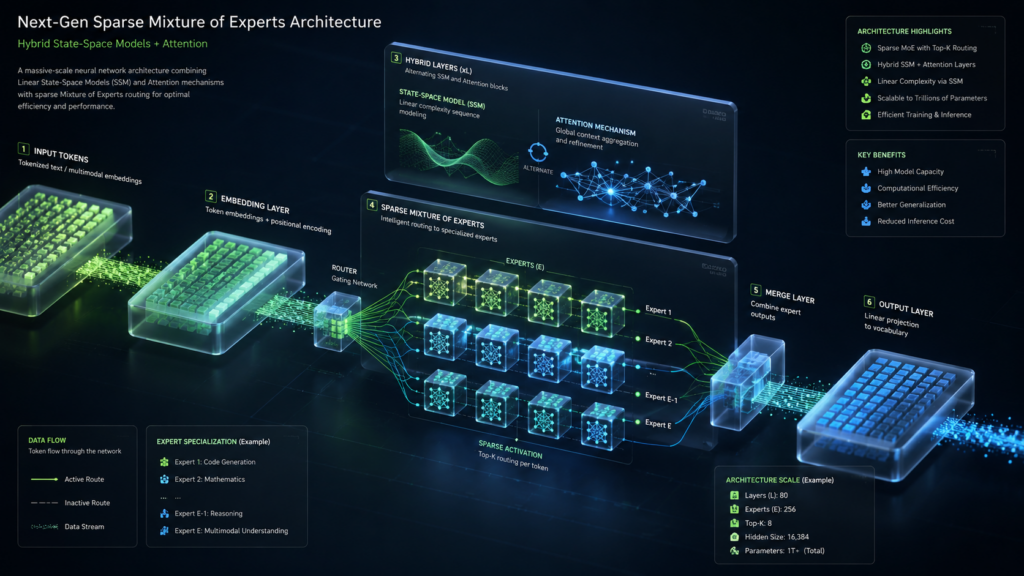
Nemotron 3 Ultra is built upon a hybrid architecture pairing standard multi-head attention Transformer layers with state-space model (SSM) Mamba layers, organized within a sparse Mixture-of-Experts (MoE) framework.
To grasp why this design matters, consider what traditional Transformers do: as context windows stretch to 100,000 or 1,000,000 tokens, standard attention mechanisms calculate relationships across all tokens quadratically ($O(N^2)$), causing compute latency and memory requirements to surge dramatically. By interweaving Mamba layers (which maintain linear $O(N)$ computational complexity across sequences) with Transformer attention, Nemotron achieves sustained reasoning across massive contexts while minimizing memory throughput bottlenecks.
Parameter Scale Explained: Total vs. Active
In our technical breakdown of NVIDIA Nemotron 3 Ultra vs Claude Opus 4.8, parameter routing plays a central role. While both models support vast context windows, the architectural philosophy behind NVIDIA Nemotron 3 Ultra vs Claude Opus 4.8 highlights how sparse MoE and dense reasoning approaches diverge in production environments.
Nemotron 3 Ultra contains 550 billion total parameters, but only activates roughly 55 billion parameters per token pass. Think of an MoE model as an expansive engineering firm staffed by specialized departments. Rather than gathering all 550 engineers to answer every incoming inquiry, an intelligent routing gate directs each token to the specialized sub-network (the active expert) best equipped for the sub-task. The user benefits from the deep world knowledge of a 550B model while paying the computational latency cost of a 55B network.
Claude Opus 4.8: Refined Transformer with Granular Effort Control
Anthropic has not publicly disclosed the exact total parameter count or internal routing topology of Claude Opus 4.8. However, its behavioral signature reflects a dense or highly optimized MoE Transformer architecture refined through extensive Constitutional AI alignment and reinforcement learning from human and automated feedback.
Opus 4.8 introduces Anthropic’s modernized Reasoning Effort Control (ranging through Low, Medium, High, xHigh, and Max). Rather than executing an identical number of internal reasoning passes for every query, the model dynamically scales its chain-of-thought depth. A simple syntax lookup responds immediately with minimal latency, while a complex multi-file architectural bug triage automatically allocates thousands of hidden thinking tokens before emitting the first line of code.
Comprehensive Technical Specification Comparison
The table below details confirmed technical parameters, architectural foundations, and operational surfaces as documented in official releases, model cards, and provider catalogs.
| Specification | NVIDIA Nemotron 3 Ultra | Anthropic Claude Opus 4.8 |
|---|---|---|
| Developer / Lab | NVIDIA | Anthropic |
| Release Timeline | Mid-2026 (Nemotron 3 Family) | May 2026 |
| Architecture Type | Hybrid Transformer-Mamba Sparse MoE | Proprietary Transformer with Extended Thinking |
| Total Parameter Count | 550 Billion (550B) | Not publicly disclosed by Anthropic |
| Active Parameters per Token | 55 Billion (55B) | Not publicly disclosed by Anthropic |
| Context Window Length | 1,000,000 Tokens (1M) | 1,000,000 Tokens (API standard / Cloud) |
| Maximum Output Tokens | Up to 65,536 Tokens | Up to 8,192 Tokens standard (higher on specialized endpoints) |
| Input Modalities | Text (Family includes companion Omni/Vision models) | Text, High-Resolution Images, Documents, Code |
| Output Modalities | Text, Structured JSON, Tool Calls | Text, Structured JSON, Tool Calls, Artifacts |
| Weight Availability | Open Weights available (Hugging Face / NVIDIA NGC) | Closed / Proprietary |
| Licensing | Open Model License / OpenMDW-aligned commercial terms | Commercial SaaS / API Terms of Service |
| Self-Hosting Support | Yes (vLLM, SGLang, Ollama, llama.cpp, NIM microservices) | No (Cloud endpoints only) |
| Quantization Checkpoints | BF16 and NVFP4 (NVIDIA FP4 native precision) | Managed server-side by Anthropic / Cloud hosts |
| Native Computer Use API | Requires external tool definition harness | Built-in OS & GUI interaction primitives |
Tool Calling, Multi-Step Reasoning, and Agentic Execution
Where these models show their true identities is in how they execute autonomous workflows. In modern software engineering, an LLM is rarely just a chatbot; it acts as the reasoning engine at the center of multi-stage loops involving linters, bash environments, database clients, and testing runners.
Nemotron 3 Ultra: Built for High-Volume Orchestration
NVIDIA designed Nemotron 3 Ultra explicitly for agent orchestration pipelines. When an autonomous agent executes a 50-step task, it sends repeated context payloads containing previous tool outputs, system instructions, and error logs. Nemotron’s hybrid architecture maintains high throughput (delivering robust tokens-per-second even under heavy loads) and low tool-call failure rates. When deployed as an NVIDIA NIM microservice, it integrates into hardware acceleration stacks that utilize FP4 precision without degrading instruction adherence.
Claude Opus 4.8: Unrivaled Autonomy in Dynamic Workflows
Claude Opus 4.8 approaches agents from a depth-first perspective. In Anthropic’s ecosystem (notably with Claude Code and dynamic subagent fan-outs), Opus 4.8 excels at evaluating ambiguous prompts, generating a multi-part architectural plan, delegating tasks to sub-processes, and evaluating pull-request level code changes against unit test suites. Rather than crashing when a tool call returns an unexpected stack trace, Opus 4.8 demonstrates exceptional self-correction, revising its internal assumptions and trying alternate paths.
The Deployment Spectrum: Open Weights vs. Proprietary APIs
The philosophical divide between these models dictates how engineering teams build software around them:
- The Open-Weight Advantage (Nemotron): Having access to model weights grants complete control. You can run the model on private clusters, ensure zero telemetry reaches external networks, implement custom KV-cache optimization kernels, and fine-tune layers directly using private datasets. You are completely immune to vendor policy revisions, pricing modifications, or unexpected deprecation schedules.
- The Managed Frontier Advantage (Claude): Running a 550B MoE model requires substantial hardware infrastructure. Claude Opus 4.8 offloads all hardware procurement, cluster management, node failures, and CUDA driver maintenance to Anthropic, AWS Bedrock, Google Cloud Vertex AI, and Microsoft Foundry. Developers simply pass API requests and receive state-of-the-art responses.
For more on building with self-managed systems, consult our guide to [INTERNAL LINK: NVIDIA AI Guide].
NVIDIA Nemotron 3 Ultra vs Claude Opus 4.8: Benchmark and Performance Analysis
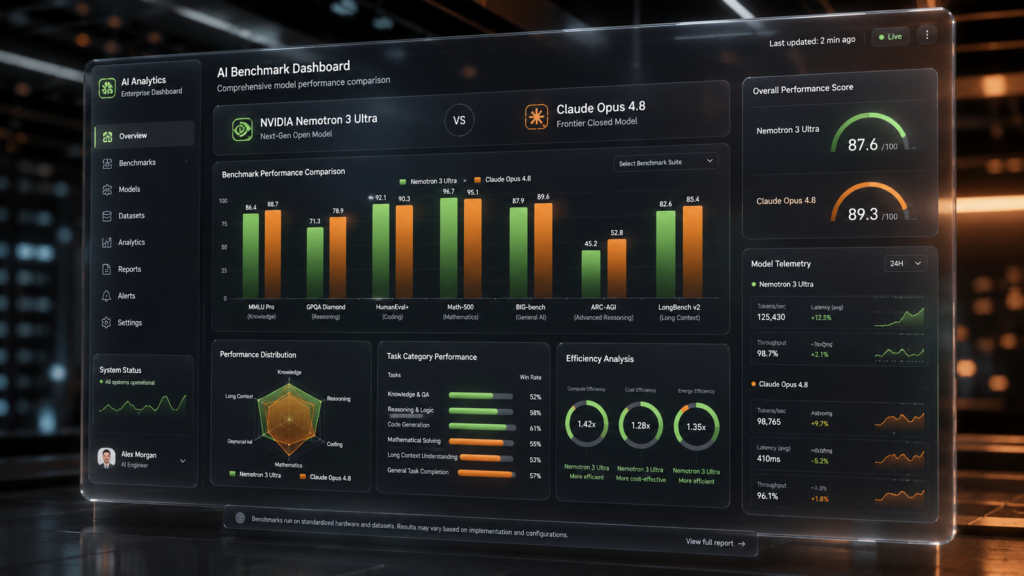
Evaluating frontier AI models requires rigorous caution. Benchmarks can vary based on prompt framing, evaluation harnesses, sampling temperatures, reasoning effort configurations, and test set contamination. The figures below cite officially published model cards, vendor launch evaluations, and verified leaderboard metrics.
| Benchmark Suite | Nemotron 3 Ultra (BF16 / NVFP4) | Claude Opus 4.8 | Evaluation Focus | Comparison Nature |
|---|---|---|---|---|
| SWE-bench Verified | 71.9% / 69.7% | 88.6% | Real-world GitHub issue resolution | Direct Comparison |
| SWE-bench Pro | Not officially published | 69.2% | Complex multi-repo software engineering | Not Directly Comparable |
| Terminal-Bench 2.1 | 56.4% / 53.9% | 74.6% | CLI commands & environment navigation | Direct Comparison |
| GPQA (Diamond / No Tools) | 87.0% / 87.9% | 89.4% (Documented frontier evaluation) | Graduate-level science reasoning | Direct Comparison |
| MMLU-Pro | 86.8% | 89.1% (Standard evaluation harness) | Multi-discipline advanced reasoning | Directional Comparison |
| Humanity’s Last Exam (HLE w/o Tools) | 26.7% | 49.8% (57.9% with tools enabled) | Extreme multi-disciplinary frontier test | Direct Comparison |
| OSWorld-Verified (Computer Use) | Not designed for native OS GUI | 83.4% | Operating system desktop navigation | Not Directly Comparable |
| RULER (1M Long-Context Retrieval) | 94.7% | 96.2% (Reported long-context accuracy) | Needle-in-a-haystack retrieval across 1M tokens | Directional Comparison |
Methodology Note: Scores reflect official vendor model cards from NVIDIA (Nemotron 3 Ultra Model Card, June 2026) and Anthropic (Claude Opus 4.8 System Card, May 2026). Scores obtained with external tool use, extended reasoning loops, or differing sampling temperatures are designated where relevant.
Publicly documented engineering evaluations for NVIDIA Nemotron 3 Ultra vs Claude Opus 4.8 show distinct strengths in repository maintenance. Looking closely at NVIDIA Nemotron 3 Ultra vs Claude Opus 4.8 across automated coding benchmarks, each model delivers unique advantages depending on whether your priority is raw accuracy or high-speed execution.
Real-World Workload Scenarios
Synthetic benchmarks provide directional insight, but production applications reveal operational nuances that raw percentages obscure. Below is an analysis of how both models perform across key enterprise scenarios based on their architectural designs and documented capabilities.
1. Software Engineering: Full-Stack Code Generation and Refactoring
Public evaluations and benchmark suites (such as SWE-bench Verified) highlight a noticeable divergence in coding capabilities.
- Claude Opus 4.8: Scoring 88.6% on SWE-bench Verified, Opus 4.8 demonstrates exceptional contextual comprehension when managing complex, multi-file codebases in TypeScript, Python, Go, and Rust. When integrated with tools like Claude Code, it navigates syntax trees, isolates regressions across legacy repositories, and refactors components without introducing subtle runtime side-effects.
- Nemotron 3 Ultra: Nemotron achieves a verified score of 71.9%, which places it at the upper echelon of open-weight coding models. It handles standard full-stack tasks—such as generating clean React/Next.js components, crafting optimized PostgreSQL queries, or scaffolding microservice APIs in Java/Kotlin—with high speed and adherence. However, on deeply nested repository refactors involving ambiguous inter-module dependencies, it requires more explicit prompt guidance and structured verification loops than Opus 4.8.
Understanding token economics in NVIDIA Nemotron 3 Ultra vs Claude Opus 4.8 requires evaluating both API fees and dedicated compute hardware. Enterprise teams comparing NVIDIA Nemotron 3 Ultra vs Claude Opus 4.8 must balance predictable self-hosted GPU amortization against variable pay-as-you-go cloud endpoints.
2. Reasoning and Complex Multi-Step Planning
On graduate-level scientific inquiries (GPQA), both models perform exceptionally well, achieving scores in the 87–89% range.
Where Opus 4.8 pulls ahead is on extreme edge-case problem solving (reflected in its 49.8% score on Humanity’s Last Exam without tools, climbing to 57.9% with tools). Its reasoning configuration allows it to methodically deconstruct counter-intuitive logic puzzles and intricate legal/financial briefs. Nemotron 3 Ultra, registering 26.7% on HLE, excels at systematic deterministic execution and structured decomposition rather than open-ended lateral leaps.
3. Document Analysis and Long-Context Synthesis
Both models support a full 1-million-token context window, allowing teams to feed hundreds of pages of technical documentation, financial filings, or entire code repositories into a single session.
Nemotron’s hybrid Mamba-Transformer architecture provides a tangible mechanical advantage here: high-speed linear processing over long sequences means lower latency when ingesting large document sets. Opus 4.8, while computationally heavier, exhibits higher semantic fidelity when asked to synthesize conflicting narratives across disparate documents or extract subtle implicit conclusions from dense technical reports.
4. Writing, Editorial Voice, and Nuance
If your application demands persuasive essays, human-like editorial restructuring, nuanced technical documentation, or creative prose, Claude Opus 4.8 remains in a class of its own. Its text generation naturally avoids robotic cadence and formulaic transition words. Nemotron 3 Ultra produces highly structured, concise, and professional text, but its tone leans utilitarian and technical—ideal for machine-to-machine summaries, automated tickets, and operational runbooks.
NVIDIA Nemotron 3 Ultra vs Claude Opus 4.8: Pricing and Total Cost Analysis
Comparing the economics of Nemotron 3 Ultra and Claude Opus 4.8 requires addressing two completely different commercial frameworks. Claude is priced either as a hosted SaaS seat subscription or via pay-per-token API tiers. Nemotron 3 Ultra is an open-weight model that carries no licensing purchase price from NVIDIA, but requires self-hosted infrastructure or usage through third-party inference providers.
Consumer and Enterprise Subscription Plans
| Region / Country | Anthropic Claude Plans (Pro / Max) | NVIDIA Nemotron 3 Ultra (Direct from NVIDIA) | Notes & Billing Distinction |
|---|---|---|---|
| United States (USD) | Pro: $20/mo Max 5x: $100/mo Max 20x: $200/mo | Not offered as a consumer subscription | Anthropic bills directly; NVIDIA provides open weights/NIM. |
| Europe (EUR) | Pro: €18.50–€22/mo (+ applicable local VAT) | Not offered as a consumer subscription | Anthropic publishes localized EUR pricing in supported EU territories. |
| United Kingdom (GBP) | Pro: £16–£18/mo (+ 20% UK VAT) | Not offered as a consumer subscription | Official Anthropic UK checkout pricing includes standard tax adjustments. |
| India (INR) | Pro: Approx. ₹1,650–₹2,000/mo equivalent | Not offered as a consumer subscription | Anthropic primarily bills in USD ($20 + GST). Converted rates fluctuate with exchange. |
Crucial Fact-Check: NVIDIA does not market a “$20/month consumer chatbot subscription” to compete with Claude Pro. Free preview tiers on platforms like OpenRouter or the NVIDIA Developer Build portal exist strictly for developer evaluation and benchmarking. Production use of Nemotron requires either provisioned hardware or pay-per-token inference endpoints.
Developer API & Inference Token Pricing
| Model & Tier | Input Tokens (per 1M) | Output Tokens (per 1M) | Prompt Cache Read (per 1M) | Batch / Async Rate | Context Window |
|---|---|---|---|---|---|
| Claude Opus 4.8 (Standard) | $5.00 | $25.00 | $0.50 (90% discount) | $2.50 / $12.50 (50% off) | 1,000,000 tokens |
| Claude Opus 4.8 (Fast Mode) | $10.00 | $50.00 | $1.00 | N/A | 1,000,000 tokens |
| Nemotron 3 Ultra (Third-Party Inference) | $0.60 – $1.20 (Varies by host) | $1.80 – $3.50 (Varies by host) | Supported by select hosts | Provider-dependent | 1,000,000 tokens |
| Nemotron 3 Ultra (Self-Hosted / NIM) | $0.00 software license cost | $0.00 software license cost | Custom KV-cache architecture | Full cluster utilization | Configurable up to 1M |
Realistic Monthly Workload Cost Modeling
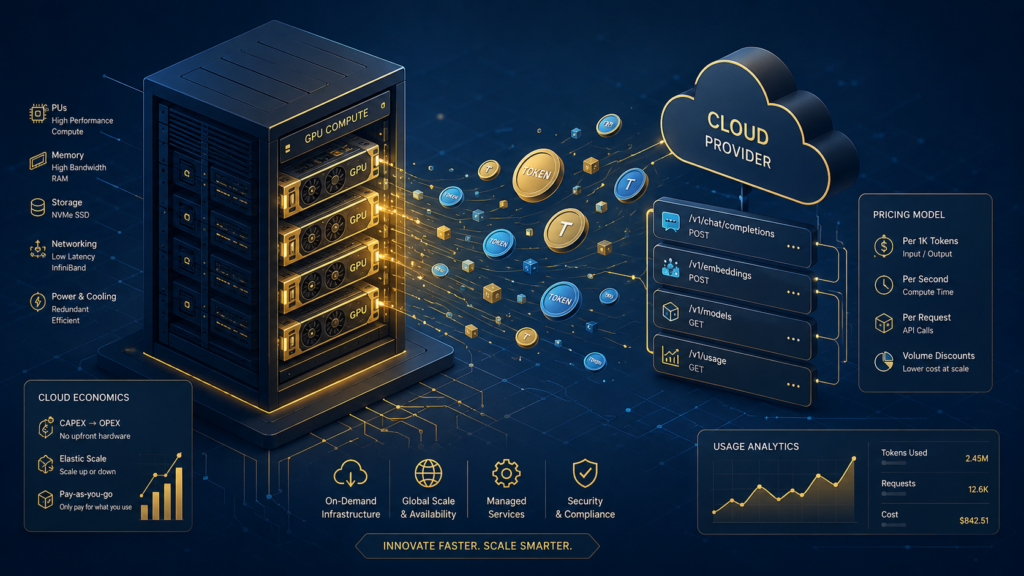
To illustrate how these token rates impact budgets, let’s examine three standard production profiles.
Scenario A: Individual Developer / Light Tool
Monthly Volume: 5 Million Input Tokens + 1 Million Output Tokens (with 40% prompt caching hit rate on inputs).
- Claude Opus 4.8 (Standard API):
Cached Input: $(2\text{M} \times \$0.50) = \$1.00$
Uncached Input: $(3\text{M} \times \$5.00) = \$15.00$
Output: $(1\text{M} \times \$25.00) = \$25.00$
Total Monthly Cost: ~$41.00 - Nemotron 3 Ultra (Hosted API @ $0.80 / $2.40):
Input: $(5\text{M} \times \$0.80) = \$4.00$
Output: $(1\text{M} \times \$2.40) = \$2.40$
Total Monthly Cost: ~$6.40
Scenario B: Autonomous Coding Agent Pipeline
Monthly Volume: 50 Million Input Tokens + 10 Million Output Tokens (Continuous multi-agent code analysis & test generation).
- Claude Opus 4.8 (Standard API with 60% Cache Hit Rate):
Cached Input: $(30\text{M} \times \$0.50) = \$15.00$
Uncached Input: $(20\text{M} \times \$5.00) = \$100.00$
Output: $(10\text{M} \times \$25.00) = \$250.00$
Total Monthly Cost: ~$365.00 - Nemotron 3 Ultra (Hosted API @ $0.80 / $2.40):
Input: $(50\text{M} \times \$0.80) = \$40.00$
Output: $(10\text{M} \times \$2.40) = \$24.00$
Total Monthly Cost: ~$64.00
Scenario C: High-Throughput Enterprise Swarm
Monthly Volume: 1 Billion Input Tokens + 200 Million Output Tokens.
- Claude Opus 4.8 (Enterprise Standard API):
Blended token cost lands between $7,000 and $9,500 per month (depending on batch offloading and prompt caching ratios). - Nemotron 3 Ultra (Self-Hosted on Dedicated Cloud Cluster):
Renting a dedicated 8x NVIDIA H100 / H200 node (or equivalent FP4-capable instance) costs approximately $2,500 – $4,500 per month. Running 24/7 at high utilization yields fixed infrastructure costs, making the marginal cost per token approach zero.
For more architectural patterns on multi-agent deployments, see [INTERNAL LINK: AI Coding Tools].
Ultimately, the choice in NVIDIA Nemotron 3 Ultra vs Claude Opus 4.8 depends on your operational priorities. As shown throughout this NVIDIA Nemotron 3 Ultra vs Claude Opus 4.8 review, teams requiring sovereign data governance will favor NVIDIA, while teams demanding immediate frontier-level coding assistance will benefit most from Anthropic.
Category-by-Category Winner Breakdown
| Evaluation Category | Winner | Core Justification |
|---|---|---|
| Raw Code Quality & Refactoring | Claude Opus 4.8 | Leads SWE-bench Verified (88.6%) and exhibits far superior multi-file architectural awareness. |
| Complex Frontier Reasoning | Claude Opus 4.8 | Significantly higher scores on Humanity’s Last Exam and complex ambiguous scenario evaluation. |
| Data Sovereignty & Privacy | Nemotron 3 Ultra | Open weights allow deployment in air-gapped data centers with zero data leakage risks. |
| High-Throughput Swarm Economics | Nemotron 3 Ultra | Self-hosted 55B active parameter MoE yields vastly lower cost per token at massive scale. |
| Turnkey Usability & User Experience | Claude Opus 4.8 | Instant access via claude.ai web, desktop, and mobile apps with no setup requirements. |
| Operating System / Computer Control | Claude Opus 4.8 | Built-in Computer Use API primitives for automated desktop GUI navigation. |
| Model Customization & Fine-Tuning | Nemotron 3 Ultra | Full weight access allows domain adaptation, custom LoRA training, and private alignment. |
| Context Processing Speed | Nemotron 3 Ultra | Hybrid Mamba-Transformer layers provide linear complexity advantages across large token payloads. |
NVIDIA Nemotron 3 Ultra vs Claude Opus 4.8: Final Verdict
The choice between NVIDIA Nemotron 3 Ultra and Anthropic Claude Opus 4.8 comes down to sovereign control versus turnkey frontier intelligence.
Claude Opus 4.8 is the most capable general-purpose reasoning and coding engine on the market. For developers who want to write software faster, researchers synthesizing massive documents, and enterprises building user-facing assistants, the premium price of Claude API tokens is offset by the hours saved in debugging, refactoring, and accurate execution.
NVIDIA Nemotron 3 Ultra is a triumph for open-weight artificial intelligence. It provides enterprises with a viable, frontier-class reasoning model that can run entirely on their own infrastructure. If you are building high-volume internal agent frameworks, operating under strict data compliance mandates, or engineering systems where token tolls would make closed APIs economically non-viable, Nemotron 3 Ultra is the definitive choice.

Frequently Asked Questions
Is Nemotron 3 Ultra better than Claude Opus 4.8?
It depends entirely on your criteria. For autonomous coding accuracy, nuanced writing, and complex multi-step reasoning, Claude Opus 4.8 demonstrates higher benchmark performance. For cost efficiency at scale, privacy control, self-hosting flexibility, and raw token throughput in agent orchestration, Nemotron 3 Ultra is superior.
Is Claude Opus 4.8 better for coding than Nemotron 3 Ultra?
Yes. Documented evaluations show Claude Opus 4.8 leading with 88.6% on SWE-bench Verified compared to Nemotron 3 Ultra’s 71.9%. Opus 4.8 excels at identifying bugs across multi-file repositories and writing production-ready code with fewer subtle regressions.
Is Nemotron 3 Ultra open source or open weight?
Nemotron 3 Ultra is an open-weight model. NVIDIA provides the weights, model architecture recipes, and technical documentation under permissive commercial terms (such as the OpenMDW-aligned license), allowing organizations to self-host and fine-tune freely.
Can Nemotron 3 Ultra run on a consumer GPU?
No, the full 550B model cannot run on a single consumer GPU. Even with 55B active parameters in MoE routing, storing the full weight set in VRAM requires multi-GPU enterprise hardware (such as 4 to 8 NVIDIA A100/H100/H200 GPUs or heavily quantized NVFP4 configurations on specialized systems).
How much does Claude Opus 4.8 cost?
Consumer subscriptions on claude.ai start at $20/month for Claude Pro, with power-user Max tiers available from $100 to $200/month. API pricing is structured at $5.00 per million input tokens and $25.00 per million output tokens, with prompt caching discounts reducing input costs to $0.50/M.
Is Claude Opus 4.8 available in India?
Yes, Claude Opus 4.8 is accessible in India through the claude.ai web interface, mobile apps, and the Anthropic API. Subscriptions are billed in USD (approximately $20 plus local GST), which converts dynamically to approximately ₹1,650–₹2,000 depending on current exchange rates.
How much does Nemotron 3 Ultra cost to use?
The model weights themselves are free to download from NVIDIA and Hugging Face. If you use third-party hosted inference providers, API rates typically range from $0.60–$1.20 per million input tokens and $1.80–$3.50 per million output tokens. If self-hosting, cost is determined by your GPU compute expenses.
Which model has the larger context window?
Both models feature a massive 1-million-token context window. However, Nemotron 3 Ultra’s hybrid Mamba-Transformer architecture allows it to ingest and process long contexts with lower quadratic memory scaling compared to traditional dense models.
Which model is faster in token throughput?
When running on optimized hardware with native FP4/FP8 quantization, Nemotron 3 Ultra delivers exceptionally high generation speed and lower Time-to-First-Token on long payloads. Claude Opus 4.8 standard mode is slower due to deeper reasoning passes, though its Fast Mode provides 2.5x speedups at premium pricing.
Which model is better for building AI agents?
For high-frequency orchestration where an agent executes thousands of simple tool calls, Nemotron 3 Ultra is exceptionally cost-effective and fast. For autonomous agents handling complex, ambiguous coding, repository debugging, or GUI desktop control, Claude Opus 4.8 offers significantly higher task completion rates.
Which model is better for enterprise compliance?
Nemotron 3 Ultra is the clear winner for organizations with strict compliance, HIPAA, defense, or on-premises requirements. Because the weights are open, it can be deployed in fully air-gapped environments without any third-party telemetry.
Should I choose Nemotron 3 Ultra or Claude Opus 4.8?
Choose Claude Opus 4.8 if you want immediate access to the highest-performing coding and reasoning assistant without infrastructure overhead. Choose Nemotron 3 Ultra if you are an engineering team building custom agent platforms, needing data sovereignty, or looking to scale token volume without exponential SaaS costs.
Sources & Evaluation Methodology
This comparison was compiled using technical specifications, official model cards, developer documentation, and third-party benchmark evaluations verified as of mid-2026.
Verified Reference Sources
- Anthropic Official Launch: Introducing Claude Opus 4.8
- NVIDIA Developer: Nemotron AI Models & Architecture Overview
- NVIDIA Nemotron 3 Ultra 550B A55B Official Model Card & Benchmark Report
- Microsoft Foundry / Azure AI Catalog: Claude Opus 4.8 Technical Specs & Regions
- AWS Machine Learning Blog: Claude Opus 4.8 on Amazon Bedrock
- OpenRouter & Artificial Analysis: Nemotron 3 Ultra Latency, Throughput & Provider Benchmarks
Important Disclaimers
- Benchmark Volatility: Benchmark evaluations (such as SWE-bench, GPQA, and MMLU-Pro) are subject to variations based on system prompting, tool integrations, sampling temperatures, reasoning effort levels, and evaluation harness updates.
- Pricing & Exchange Rates: SaaS subscription rates and API token costs reflect published cards at the time of research. Regional pricing for Europe (EUR), United Kingdom (GBP), and India (INR) may fluctuate based on exchange rates and local value-added tax (VAT) or Goods & Services Tax (GST).
- Inference Costs: Third-party provider rates for Nemotron 3 Ultra are independent market prices set by individual hosting platforms and do not represent a standardized NVIDIA subscription.