
For more than four decades, quantum computing has been the ultimate technological mirage—always a decade away, perpetually confined to university laboratories, and strictly theoretical in its economic impact. The narrative, however, has abruptly shifted. The era of the “quantum science project” is ending, and the era of quantum enterprise revenue is about to begin.
In a watershed moment for the deep tech industry, IBM Chief Executive Officer Arvind Krishna recently went on the record to declare that quantum computing is rapidly approaching a commercial breakthrough. Speaking on CNBC’s Mad Money, Krishna projected that quantum systems will transition from experimental research to making a measurable, tangible impact on IBM’s top and bottom lines by 2028 or 2029.
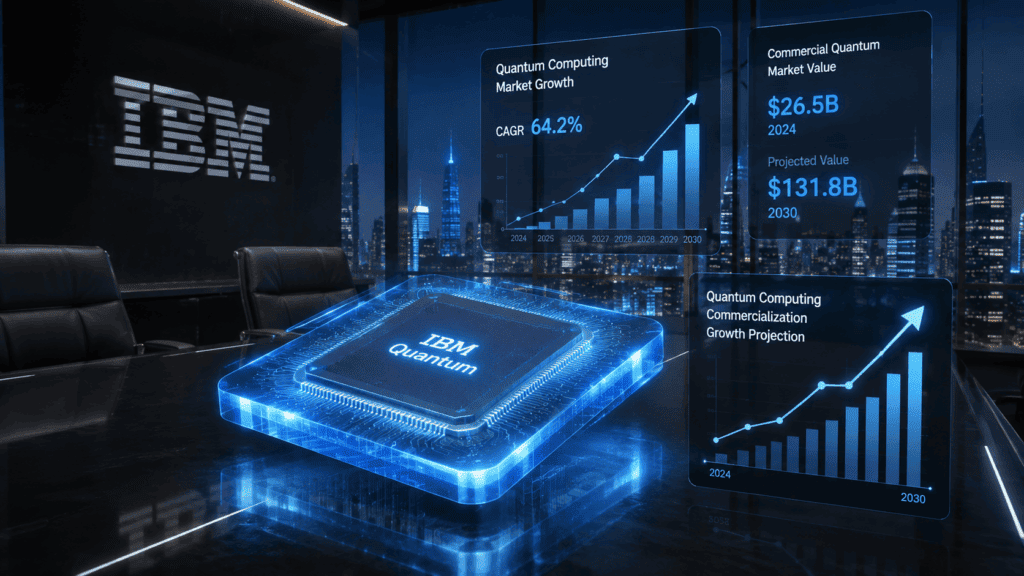
The financial scale of this transition is staggering. Krishna estimated that the technology will generate approximately $1 trillion in total economic value by the late 2030s. This is no longer speculative venture capital talk; this is a highly calculated projection from the leader of a 113-year-old enterprise computing titan. His remarks were immediately backed by unprecedented capital expenditure, including a $2 billion joint investment with the U.S. government to construct a standalone quantum chip foundry.
Why does a timeline of 2028 to 2029 matter so deeply to the technology sector? Because until now, the industry lacked a credible deadline for quantum commercialization. Corporate boards have hesitated to invest in quantum readiness, fearing they were pouring capital into an endless research sinkhole. By planting a flag at the end of this decade, IBM is sending a clear signal to Fortune 500 chief information officers, global supply chain operators, and national security agencies: the time to integrate quantum algorithms into your workflows is now, or risk total obsolescence.
This long-form analysis will deconstruct exactly how IBM plans to cross the chasm from experimental physics to enterprise product. We will explore the leap to fault-tolerant systems, the imminent arrival of the “Starling” architecture, the competitive landscape breathing down IBM’s neck, and the profound ways this technology will rewrite the rules of global industry.
Deconstructing the Physics: What Is Quantum Computing?
To understand why a $1 trillion economic projection is justified, we must first strip away the science fiction and understand the underlying physics that make quantum computers fundamentally different from the laptop or smartphone you are using to read this article.
The Classical Bottleneck
Classical computing, from the earliest mainframes to today’s most advanced artificial intelligence supercomputers, operates on a binary foundation. Information is processed in bits, representing either a one or a zero. It is essentially a universe of microscopic light switches turning on and off billions of times per second. While classical computers can perform sequential calculations at blistering speeds, they hit a brick wall when attempting to model the natural world. Nature does not operate in binary; nature operates in quantum mechanics.
Superposition and Entanglement: The Quantum Edge
Quantum computers discard the binary bit in favor of the qubit (quantum bit). Thanks to a quantum mechanical property called superposition, a qubit can exist in a state of one, zero, or a multidimensional combination of both simultaneously. If you add a second qubit, they can hold four states at once. Three qubits hold eight. The computational power scales exponentially, doubling with every qubit added to the system.
The second critical property is entanglement. When qubits become entangled, the state of one qubit instantly influences the state of another, regardless of the physical distance between them. This allows a quantum processor to evaluate millions of potential solutions to a complex problem simultaneously, rather than checking them one by one in a linear sequence like a classical machine.
The Holy Grail: Fault Tolerance and Logical Qubits
If qubits are so powerful, why aren’t they on our desks today? The answer is noise. Qubits are exceptionally fragile. Microscopic temperature fluctuations, electromagnetic radiation from Wi-Fi routers, or even stray cosmic rays can cause a qubit to lose its quantum state—an event known as decoherence. When decoherence happens, the calculation crashes.
For years, the industry has operated in the NISQ era (Noisy Intermediate-Scale Quantum). NISQ computers are powerful but error-prone. IBM’s current pivot, driving Krishna’s 2028 revenue confidence, is the leap to fault-tolerant quantum computing.
Fault tolerance is achieved through quantum error correction. Instead of relying on a single, fragile physical qubit, engineers group hundreds or thousands of physical qubits together to form one highly stable, error-corrected logical qubit. If one physical qubit within the group fails due to noise, the surrounding qubits detect the error and correct it on the fly, allowing the algorithm to run indefinitely.
Defining Quantum Advantage
The ultimate milestone in this field is “quantum advantage.” This occurs when a quantum computer can solve a useful, real-world computational problem significantly faster, cheaper, or more efficiently than the world’s most powerful classical supercomputer. IBM’s recent joint research with the startup Algorithmiq, which successfully utilized error-mitigated quantum simulation to solve complex chemical problems, serves as the preliminary spark for the commercialization fire Krishna is predicting.
The $1 Trillion Impact: Industries Slated for Disruption
A trillion dollars of economic value does not emerge from selling hardware alone; it emerges from the secondary markets and efficiencies that the hardware unlocks. When fault-tolerant quantum computers become commercially available, they will target specific classes of problems: massive combinatorial optimization, complex chemical simulations, and advanced machine learning models. Here is how that translates across global sectors.
Healthcare and Drug Discovery
Developing a new pharmaceutical drug currently takes an average of ten to fifteen years and billions of dollars, largely because simulating molecular interactions on classical computers relies on rough approximations. Molecules are inherently quantum mechanical systems. Quantum computers can simulate the exact electron interactions of complex proteins, reducing drug discovery timelines from years to days. This allows for hyper-personalized medicine and rapid responses to emerging global pathogens.
Materials Science and Battery Research
The transition to renewable energy is bottlenecked by battery storage capacity and material degradation. Quantum systems can simulate the molecular behavior of new chemical compounds, allowing engineers to design next-generation solid-state batteries with exponentially higher energy densities and faster charging times. Furthermore, quantum chemistry could unlock new, energy-efficient methods for creating fertilizers (disrupting the carbon-heavy Haber-Bosch process) and discover room-temperature superconductors.
Financial Modeling and Risk Assessment
The global financial system runs on risk modeling. Investment banks currently use classical Monte Carlo simulations to price complex derivatives and optimize portfolios. Quantum algorithms can analyze thousands of overlapping market variables—from geopolitical shifts to supply chain disruptions—simultaneously. A firm leveraging quantum portfolio optimization by 2029 will carry a mathematically insurmountable advantage over classical trading desks.
Cybersecurity and National Defense
This is the double-edged sword of the quantum era. A sufficiently powerful quantum computer running Shor’s algorithm could break the RSA encryption that currently secures the internet, banking systems, and military communications. The impending commercialization timeline is drastically accelerating the global migration to Post-Quantum Cryptography (PQC). IBM is already integrating quantum-safe encryption into its enterprise mainframes to protect clients from “harvest now, decrypt later” cyberattacks.
Artificial Intelligence Integration
While generative AI requires massive classical data processing, Quantum Machine Learning (QML) offers a different paradigm. Quantum computers can identify hidden patterns in multi-dimensional datasets that classical neural networks cannot perceive. Combining classical AI with quantum subroutines will exponentially accelerate model training and reduce the staggering energy footprint of modern AI data centers.
Manufacturing, Supply Chains, and Logistics
Global supply chains are optimization nightmares involving ships, ports, trucks, weather patterns, and shifting consumer demand. The traveling salesperson problem—finding the most efficient route among multiple stops—scales poorly on classical machines. Quantum optimization algorithms can route global shipping fleets in real-time to minimize fuel consumption and prevent the type of cascading logistical failures the world experienced during recent global disruptions.
Climate Research and Energy Grid Optimization
Modeling the Earth’s climate requires tracking billions of variables. Quantum systems will allow meteorologists to create vastly more accurate climate models, predicting severe weather events with granular precision. Furthermore, as national power grids integrate decentralized renewable energy sources like wind and solar, quantum computers can optimize grid distribution in real-time, preventing blackouts and reducing energy waste.
Inside the Forge: The IBM Quantum Hardware Roadmap
Projections mean nothing without silicon, and IBM has been exceptionally transparent about its hardware roadmap. The company has methodically moved from laboratory experiments to data center deployments. The architecture relies on superconducting transmon qubits cooled to a fraction of a degree above absolute zero.
From System One to System Two
IBM’s commercial journey began with Quantum System One, a monolithic, aesthetically striking glass cube that demonstrated qubits could be stabilized outside a physics lab. This was rapidly followed by Quantum System Two, a modular architecture deployed at select customer sites. System Two laid the groundwork for scalable cryogenic infrastructure, allowing multiple quantum processors to be linked together.
The 2029 Milestone: IBM Quantum Starling
The centerpiece of Arvind Krishna’s 2028-2029 revenue projection is a machine codenamed IBM Quantum Starling. Slated for debut by 2029 at IBM’s Poughkeepsie, New York data center, Starling represents the holy grail of this industry: a large-scale, fault-tolerant quantum computer.
Starling is designed to execute roughly 100 million quantum gates across 200 logical qubits. To achieve this, it will utilize an estimated 10,000 underlying physical qubits. The breakthrough enabling Starling is IBM’s implementation of quantum low-density parity-check (qLDPC) error-correcting codes. Older error correction methods required massive overhead—sometimes 1,000 physical qubits to yield a single logical qubit. The advanced qLDPC codes reduce this physical qubit requirement by up to 90 percent, dramatically shrinking the cooling and infrastructure requirements.
Before Starling takes flight, IBM’s roadmap includes crucial intermediate processors to test this architecture. In 2025, the Loon processor will test long-range C-coupler interconnects. In 2026, the Kookaburra modular chip will combine quantum memory with logical processing. By 2027, Cockatoo will simulate the networked nodes required for massive scaling. Every step is meticulously designed to culminate in the commercial readiness of Starling by the end of the decade.
The Capital Engine: IBM’s Ecosystem and Investment Strategy
Building a fault-tolerant quantum computer is arguably the most complex engineering challenge in human history. It cannot be done in a corporate vacuum. IBM has surrounded its hardware development with a robust, multi-layered investment strategy designed to cultivate demand before the supply is fully mature.
The $2 Billion Foundry Play
In May 2026, IBM aggressively accelerated its manufacturing capabilities by announcing a $2 billion joint investment with the U.S. government (specifically leveraging the Department of Commerce) to construct a standalone quantum chip foundry. By committing $1 billion of its own capital and securing a matching $1 billion from public funds, IBM is ensuring it controls the end-to-end supply chain for quantum silicon, insulating itself from the geopolitical supply chain vulnerabilities that currently plague classical semiconductor manufacturing.
The IBM Quantum Network and Cloud Access
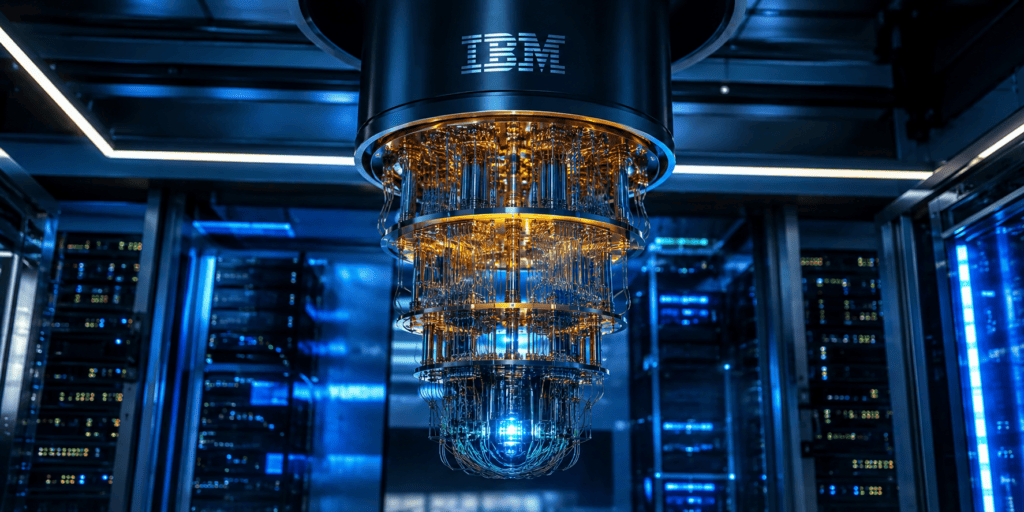
You do not need to buy a cryogenic chandelier to use an IBM quantum computer. Through IBM Cloud, the company provides researchers, developers, and enterprise clients direct access to its quantum fleet. The IBM Quantum Network has enrolled hundreds of Fortune 500 companies, academic institutions, and national laboratories. These partners are actively developing proprietary quantum algorithms today, ensuring they are ready to deploy the moment Starling comes online.
The Developer Ecosystem: Qiskit
Hardware is useless without software. IBM pioneered Qiskit, an open-source quantum software development kit built on Python. By making Qiskit the de facto programming language for quantum circuits, IBM is aggressively capturing mindshare among the next generation of software engineers. The strategy mirrors the historical rise of enterprise operating systems: control the software ecosystem, and the hardware revenue will follow.
The Quantum Cold War: Evaluating the Competitive Landscape
IBM is not operating in a monopoly. The race to fault-tolerant quantum computing is a geopolitical and corporate cold war, featuring the deepest pockets in the technology sector. The competitors are not just fighting over market share; they are fighting over fundamentally different physics architectures.
| Company | Primary Modality | Core Advantage | Primary Challenge | Market Strategy |
|---|---|---|---|---|
| IBM | Superconducting Transmons | Fast gate speeds, massive enterprise footprint | Requires extreme cryogenic cooling (millikelvin) | End-to-end full stack cloud services |
| Google Quantum AI | Superconducting | Historic “quantum supremacy” proof, vast AI integration | Similar cryogenic hurdles to IBM | Deep integration with Google Cloud & AI |
| Microsoft | Topological Qubits | Theoretically superior native error resistance | Physics are incredibly difficult to engineer | Azure Quantum ecosystem aggregator |
| IonQ / Quantinuum | Trapped Ions | Exceptional qubit fidelity, operates at room temp (in vacuum) | Slower gate operation times compared to superconducting | Hardware integration into AWS, Azure, Google Cloud |
| PsiQuantum | Photonic | Uses existing classical silicon fab techniques, light-based | Requires massive optical networking infrastructure | Skipping NISQ entirely to build a 1M qubit system |
| Amazon (AWS Braket) | Neutral Atoms / Aggregator | Largest cloud customer base, hardware agnostic approach | Less internal hardware dominance than IBM/Google | Marketplace provider offering multiple quantum backends |
While companies like IonQ are making tremendous strides with trapped ion architectures, and PsiQuantum is betting billions on photonics, IBM’s distinct advantage is its deep-rooted legacy of enterprise trust. Fortune 500 companies already run their most sensitive mainframe workloads on IBM hardware. Persuading a global bank to transition its classical risk modeling to an IBM quantum system is a frictionless enterprise sales cycle compared to a startup attempting to win that same contract.
The Reality Check: Roadblocks on the Path to 2028
Despite the optimism radiating from Arvind Krishna’s timeline, deploying a globally viable, commercial quantum infrastructure is fraught with immense engineering and macroeconomic challenges. To avoid the peril of quantum hype, we must examine the friction points.
The Cryogenic Bottleneck
Superconducting qubits must operate at temperatures colder than deep space—specifically around 15 millikelvins. Maintaining these temperatures requires massive, complex, and highly expensive dilution refrigerators that consume significant amounts of power and liquid helium. Scaling a data center to house tens of thousands of logical qubits requires a revolution in cryogenic engineering. The cooling infrastructure alone is a massive capital expenditure hurdle.
The Calibration Crisis
Quantum computers are highly temperamental. They require constant calibration to maintain fidelity. A minor fluctuation in the ambient electromagnetic environment can skew results. Transitioning a system from a lab—where a team of PhD physicists monitors it continuously—to a commercial cloud environment boasting 99.999% uptime requires autonomous calibration software that has yet to be fully perfected.
The Talent Drought
There is a severe global shortage of quantum-native talent. Building the hardware requires niche expertise in quantum physics and materials science, while writing the software requires a fundamentally new approach to algorithmic logic. While classical developers think linearly, quantum developers must think probabilistically. The enterprise sector will struggle to find enough qualified quantum algorithm developers to deploy these solutions by 2028, potentially slowing commercial adoption.
Cost and ROI Justification
Early access to fault-tolerant quantum computers will be exorbitantly expensive. Chief Financial Officers will demand immediate return on investment. If the first commercial quantum applications only offer a marginal improvement over classical AI or supercomputing clusters, enterprise buyers will defer adoption. The technology must deliver absolute, undeniable quantum advantage out of the gate to justify the premium.
Commercialization in Action: Navigating the Business Impact
When the 2028-2029 window arrives, the rollout will not look like the launch of a new consumer smartphone. It will be a phased integration embedded deeply within enterprise cloud services.
Chemical companies will lease quantum time to simulate novel polymer chains, shifting R&D expenses from physical laboratories to cloud-based simulations. Logistics conglomerates will integrate quantum routing APIs into their existing classical software stacks; the end-user truck driver will never know their route was optimized by a machine operating at absolute zero. The semiconductor industry itself will use quantum computers to design the next generation of classical chips, discovering new ways to bypass the physical limits of Moore’s Law.
However, the risks of a timeline failure are significant. If IBM’s Starling system encounters unforeseen physics bottlenecks, or if error correction proves more elusive at scale than current qLDPC models predict, the industry could face a “Quantum Winter.” Investor capital, heavily reliant on Krishna’s late-2020s timeline, could dry up, pushing the $1 trillion economic realization deep into the 2040s. Furthermore, the geopolitical risk of export controls on quantum hardware—given its dual-use potential for national security and cryptography—could fragment the global market, preventing multinational corporations from deploying unified quantum strategies.
Expert Analysis: Decoding the CEO’s Statements
Arvind Krishna’s decision to place a hard date on quantum revenue is a calculated, strategic maneuver. By stating on CNBC, I think that in 2028 or 2029, you’ll see it have a measurable impact on our top line and bottom line,
Krishna is not merely addressing Wall Street analysts; he is addressing his enterprise customer base. He is validating the capital expenditures required for clients to begin transitioning their data architectures today.
His projection of a $1 trillion economic value by the late 2030s aligns with broader macroeconomic consensus on the value of solving intractable optimization problems. By investing $1 billion into a dedicated foundry now, matched by government CHIPS funding, IBM is signaling that the theoretical physics phase is functionally complete. The company is transitioning into a manufacturing and supply chain phase. When a technology shifts from the purview of theoretical physicists to the desks of supply chain managers and enterprise sales directors, commercialization is truly imminent.
Frequently Asked Questions: Quantum Commercialization by 2028
- What exactly did IBM’s CEO predict regarding quantum computing?
- IBM CEO Arvind Krishna stated that quantum computing will exit the pure research phase and begin making a measurable, tangible contribution to IBM’s revenue and profit by the years 2028 or 2029. He also predicted the technology will create roughly $1 trillion in total economic value by the late 2030s.
- Why is the 2028-2029 timeline so important?
- Historically, quantum computing timelines have been vague and constantly shifting. Providing a definitive, near-term window gives enterprise clients the confidence to begin investing in quantum-readiness software and training without fearing the technology is permanently stuck in the lab.
- What is IBM Quantum Starling?
- Scheduled for deployment by 2029 at IBM’s Poughkeepsie facility, Starling is slated to be IBM’s first large-scale, fault-tolerant quantum computer. It aims to support 200 logical qubits and execute up to 100 million quantum gates, utilizing highly advanced qLDPC error-correcting codes.
- What is a logical qubit versus a physical qubit?
- A physical qubit is the actual hardware component (like a superconducting circuit) holding a quantum state. Because physical qubits are easily disrupted by noise, engineers group many of them together using error-correction algorithms to create a single, highly stable “logical qubit” capable of sustained computation.
- How is IBM funding its quantum manufacturing?
- In May 2026, IBM announced a $2 billion joint investment to build a standalone quantum chip foundry. IBM is contributing $1 billion, which is matched by another $1 billion from the U.S. government via the Department of Commerce.
- Will quantum computers replace classical computers?
- No. Quantum computers will work alongside classical computers. You will not have a quantum processor in your smartphone. Classical systems will continue to handle daily tasks (email, basic software, standard AI), while quantum systems will be accessed via the cloud to solve specific, highly complex mathematical and chemical problems.
- How will quantum computing impact healthcare?
- Quantum computers can simulate molecular structures and electron interactions with perfect accuracy, drastically reducing the time and cost required to discover new pharmaceutical drugs and tailor highly personalized medical treatments.
- What is quantum advantage?
- Quantum advantage is the definitive threshold where a quantum computer solves a practical, real-world computational problem faster, cheaper, or more accurately than any traditional classical supercomputer could ever achieve.
- Does quantum computing pose a threat to cybersecurity?
- Yes, in the long term. A fault-tolerant quantum computer could theoretically break standard RSA encryption. In preparation, governments and enterprise tech companies, including IBM, are currently rolling out Post-Quantum Cryptography (PQC) to secure data against future quantum threats.
- Who are IBM’s main competitors in the quantum space?
- Major competitors include Google Quantum AI, Microsoft Azure Quantum, Amazon Web Services (AWS Braket), alongside dedicated quantum hardware companies such as IonQ, Rigetti, Quantinuum, and PsiQuantum.
- Why do quantum computers need to be so cold?
- IBM uses superconducting qubits, which only exhibit quantum mechanical properties and remain stable when cooled to roughly 15 millikelvins—a temperature colder than deep space. This prevents ambient heat and radiation from collapsing the delicate quantum state.
- How is IBM combating the quantum talent shortage?
- IBM is heavily investing in the IBM Quantum Network and its open-source Qiskit development platform. By training thousands of university students and software developers on Qiskit today, IBM ensures an active workforce is ready when the hardware matures.
- What role did the startup Algorithmiq play in recent developments?
- IBM recently partnered with Algorithmiq to demonstrate quantum advantage using error-mitigated quantum simulation. The successful resolution of complex chemical problems verified that IBM’s hardware can perform tasks beyond the reach of conventional supercomputers.
- Can I buy an IBM quantum computer?
- While IBM has deployed Quantum System One and Two at select client sites (such as the Cleveland Clinic), the primary commercial model relies on cloud access. Enterprises pay to access quantum processing power securely over the IBM Cloud.
- What happens if IBM misses the 2028-2029 deadline?
- If significant engineering hurdles delay commercialization, the industry risks a “quantum winter”—a period where enterprise investment and venture capital evaporate due to unmet expectations, potentially delaying the technology’s integration by a decade or more.
Key Takeaways
- Hard Deadlines Drive the Market: IBM CEO Arvind Krishna’s commitment to seeing quantum revenue by 2028-2029 provides a vital signal to enterprise CIOs that quantum technology is moving from R&D to active enterprise deployment.
- Hardware Leap: The 2029 launch of the fault-tolerant IBM Quantum Starling system, capable of supporting 200 logical qubits, represents the technological catalyst required to achieve commercial scalability.
- Massive Economic Value: By solving intractable problems in logistics, drug discovery, materials science, and finance, the quantum ecosystem is realistically projected to unlock $1 trillion in economic value by the late 2030s.
- Infrastructure Independence: The $2 billion standalone quantum chip foundry backed by the U.S. government ensures IBM can scale manufacturing securely, insulating the quantum supply chain from global semiconductor bottlenecks.
- Error Correction is Everything: The commercial viability of quantum computing relies entirely on shifting from noisy physical qubits to highly stable, error-corrected logical qubits, a feat IBM is tackling through advanced qLDPC coding.
The Final Verdict
Quantum computing has historically operated under a cloud of scientific mysticism, viewed by the business sector as a futuristic marvel perpetually out of reach. IBM’s recent strategic pivots—anchored by CEO Arvind Krishna’s definitive 2028-2029 revenue timeline, the development of the fault-tolerant Starling architecture, and a multi-billion-dollar government-backed manufacturing foundry—have effectively shattered that illusion.
The transition from experimental physics to enterprise profit and loss is no longer a matter of ‘if’, but ‘when’—and IBM has circled the date on the calendar. While extreme engineering challenges involving cryogenics and error correction remain, the architecture required to solve them is now fully blueprinted. For corporate leaders, policymakers, and software developers, the grace period of simply watching quantum computing from the sidelines has expired. The race toward the $1 trillion quantum economy has officially begun, and the cost of arriving late will be computational irrelevance.