


Nikon D850 Review: Is This 45.7MP DSLR Still Worth Buying in 2026?
When Nikon launched the D850 in August 2017 to coincide with the company’s 100th anniversary, it was hailed as the undisputed pinnacle of digital single-lens reflex (DSLR) engineering. Fast forward to 2026, and the photography landscape has been thoroughly revolutionized by mirrorless architectures like the Nikon Z8 and Sony A7 IV. Yet, the Nikon D850 stubbornly refuses to fade into obscurity. With its groundbreaking 45.7-megapixel backside-illuminated (BSI) CMOS sensor, an optical viewfinder that connects you directly to the light, and a tank-like magnesium alloy chassis, this legendary camera remains a formidable tool for those who prefer the tactile, immediate experience of a traditional DSLR. But is a Nikon D850 review even relevant today? Is it actually worth buying in 2026, or is it finally time to let the mirrorless revolution take complete control?
Introduction, Design, Build Quality, and Ergonomics
What the Nikon D850 Is (And What It Isn’t)
To understand the Nikon D850 in 2026, you must understand its DNA. The D850 is a professional-grade, FX-format (full-frame) DSLR designed to deliver uncompromising resolution without sacrificing speed. It was the camera that proved you didn’t have to choose between high megapixels and fast frame rates. Designed primarily for working professionals—landscape purists, studio portraitists, commercial shooters, and even wildlife photographers—the D850 represented the apex of Nikon’s F-mount technological development before the Z-mount took priority.
In 2026, the Nikon D850 is not the camera you buy for cutting-edge computational photography, AI-driven subject recognition, or seamless run-and-gun hybrid video. If you need a camera that can track a bird’s eye across the frame with zero latency while shooting 8K RAW video, you are looking at the wrong system. Instead, the D850 is a precision optical instrument. It is designed for the photographer who wants absolute maximum dynamic range, the vast optical ecosystem of Nikon F-mount glass, and a battery that lasts for days, not hours.
Design and Build Quality
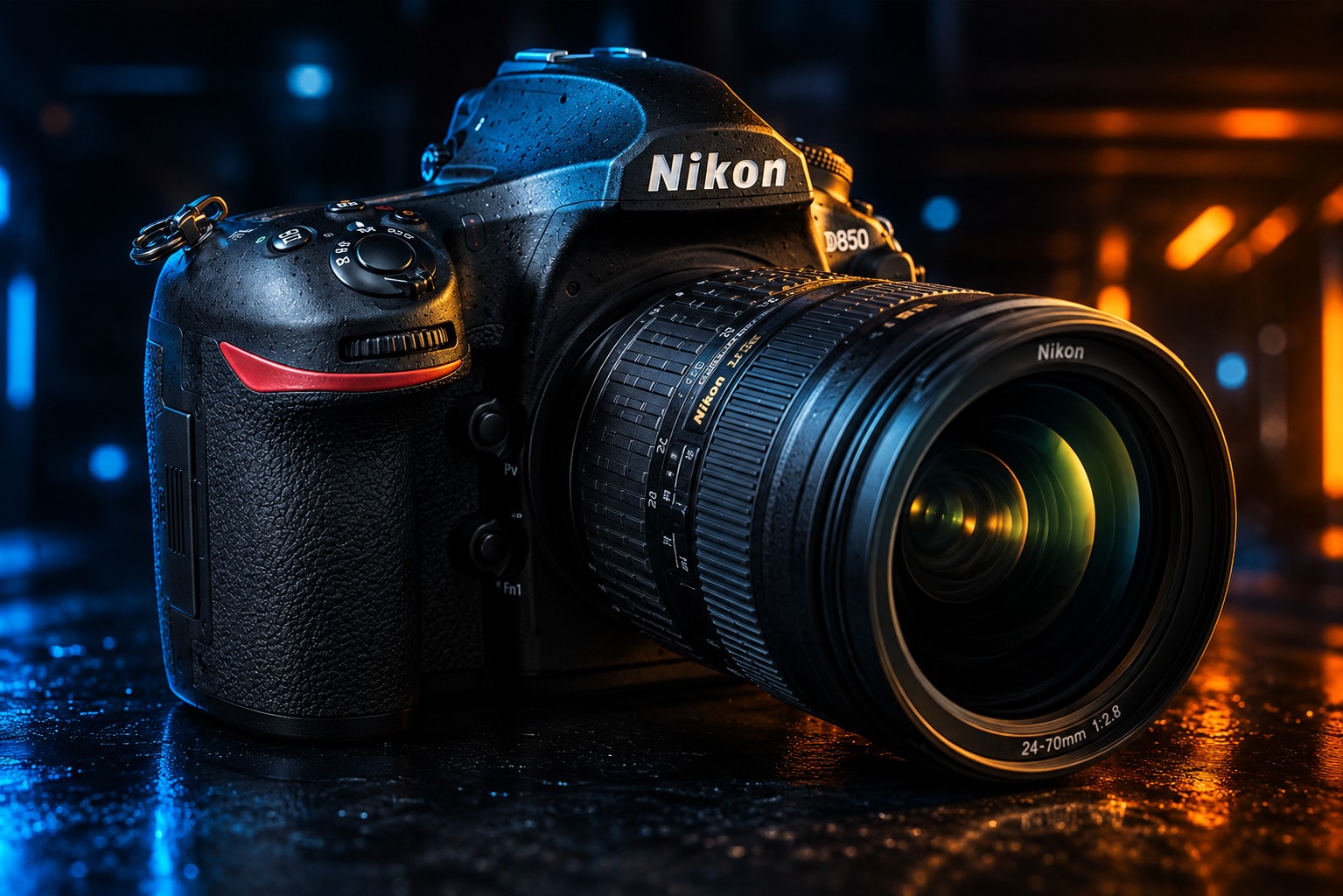
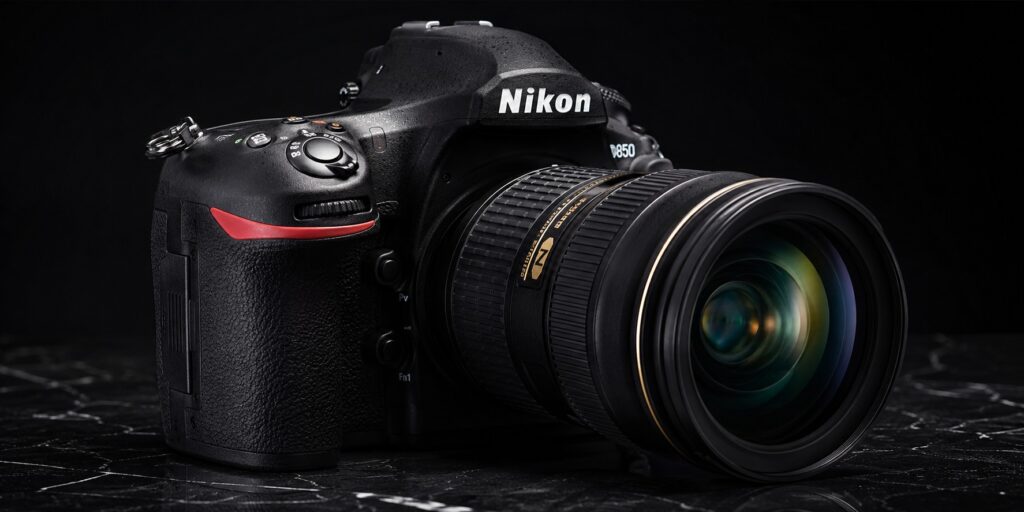
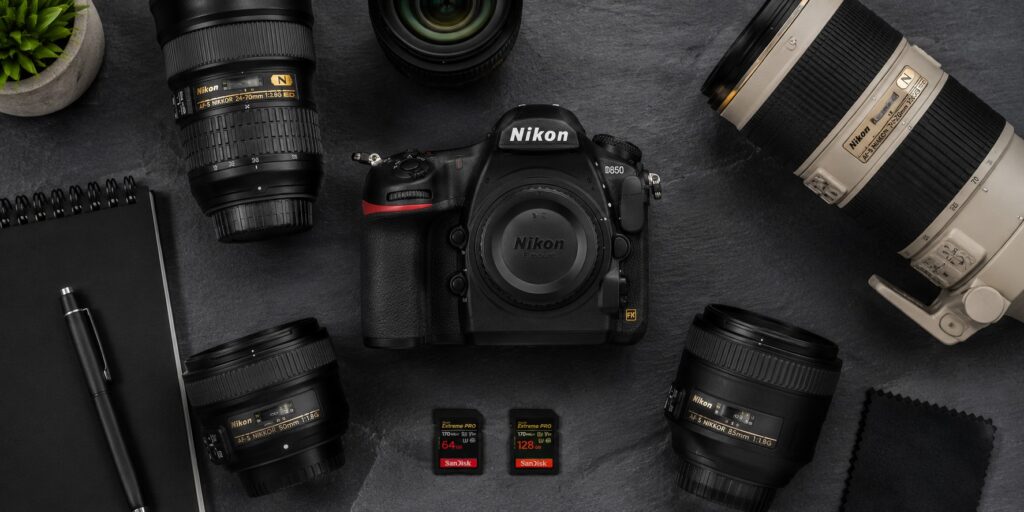
Picking up the Nikon D850 immediately communicates its intended audience: professionals who subject their gear to abuse. The chassis is constructed almost entirely from magnesium alloy, ensuring structural rigidity that modern lightweight mirrorless bodies often lack. Weighing in at approximately 915g (body only) and roughly 1005g with a battery and XQD/CFexpress card inserted, it is undeniably heavy. Paired with professional “gold ring” F-mount lenses like the 70-200mm f/2.8E FL ED VR, you are carrying a significant amount of weight. In 2026, where the trend is ultra-lightweight travel kits, the D850’s heft is polarizing. Some find it cumbersome; others find the mass reassuring, particularly as it helps balance large telephoto lenses and dampens mirror slap vibration.
The weather sealing on the D850 remains spectacular. Nikon engineered this camera to shoot in torrential rain, freezing Himalayan blizzards, and sweltering desert dust storms. The rubber gaskets sealing the battery compartment, memory card doors, and port covers are thick and resilient. Even after years of use in the secondary market, a well-maintained D850 holds up beautifully against the elements.
Ergonomics, Grip, and Controls
The ergonomics of the D850 are, arguably, perfect for a camera of this size. The grip is exceptionally deep—significantly deeper and narrower than its predecessor, the D810—allowing your fingers to wrap fully around the body. This provides immense leverage and comfort during long shoots.
Nikon’s control layout here is a masterclass in professional camera design. There is a dedicated physical button or dial for almost every critical shooting parameter: ISO, White Balance, Exposure Compensation, Quality, and Drive Mode. In 2026, as some manufacturers move toward minimalist, menu-heavy interfaces, the D850’s tactile, button-heavy philosophy is deeply refreshing. You can operate this camera entirely by muscle memory without ever taking your eye away from the viewfinder. Furthermore, Nikon thoughtfully included illuminated buttons—a feature that astrophotographers and wedding shooters working in dark reception halls continue to praise endlessly.
The Optical Viewfinder and LCD Touchscreen
One of the primary reasons to buy a DSLR in 2026 is the optical viewfinder (OVF), and the D850 features one of the best ever made. The pentaprism OVF offers 100% frame coverage with a massive 0.75x magnification. It is incredibly bright, massive, and entirely devoid of the digital lag, refresh rate tearing, or pixelation that can occasionally plague electronic viewfinders (EVFs) in extreme low light. Looking through the D850’s viewfinder is literally looking through the lens at reality at the speed of light.
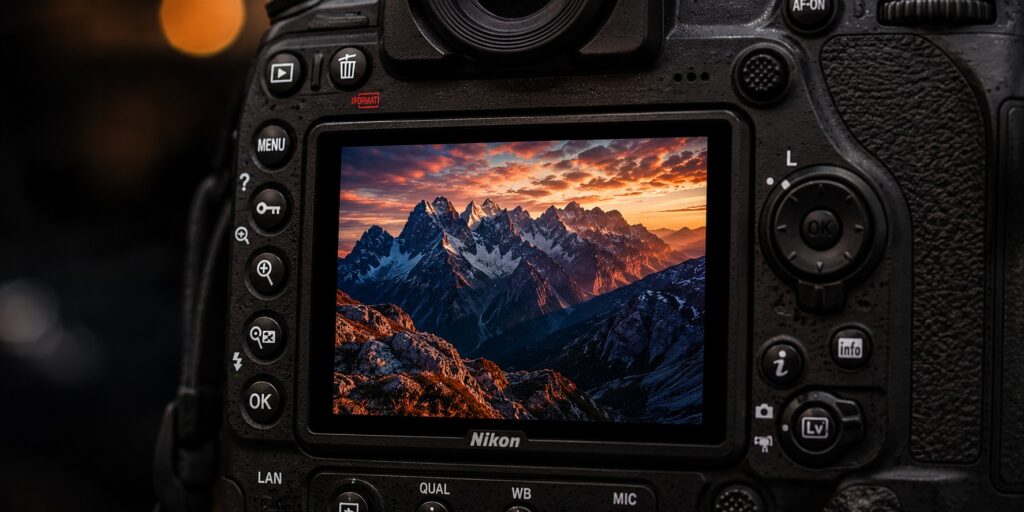
Below the viewfinder sits a 3.2-inch tilting TFT LCD touchscreen with 2.36 million dots of resolution. While it lacks the fully articulating vari-angle mechanism found on many modern hybrid cameras, the tilt mechanism is incredibly robust and perfect for low-angle landscape or macro work. The touch interface is highly responsive, allowing for quick menu navigation, image playback pinching/zooming, and touch-to-focus in Live View mode—though the Live View autofocus speed itself is a historical weakness we will address later.
DSLR Advantages and Disadvantages in 2026
Evaluating real-world handling in 2026 requires contextualizing the DSLR architecture against modern mirrorless systems. The advantages of the D850’s DSLR design include zero-latency optical viewing, extraordinary battery life (because powering a sensor and EVF constantly drains mirrorless batteries rapidly), and a ruggedness that feels virtually indestructible. However, the disadvantages are equally apparent. The presence of a mirror box necessitates a flange distance that makes the camera inherently thicker. It also means that autofocus during video or Live View relies on older contrast-detect technology, and you do not get to see a real-time exposure simulation through the viewfinder before you press the shutter. You must rely on the light meter and your own understanding of exposure—a process that purists love, but modern beginners find intimidating.
Sensor, Image Quality, and Photography Performance
The 45.7MP BSI CMOS Sensor
At the absolute heart of any Nikon D850 review is the sensor. Nikon utilized a custom-designed 45.7-megapixel full-frame FX-format Backside-Illuminated (BSI) CMOS sensor. Crucially, Nikon omitted the optical low-pass filter (OLPF), maximizing the resolving power and micro-contrast delivered to the pixel level. What does 45.7MP actually mean in practical photography? It means you are capturing images at 8256 x 5504 pixels. This translates to the ability to print native 27 x 18-inch fine art prints at 300 DPI without any software upscaling.
The BSI architecture was a critical inclusion. By moving the wiring circuitry below the light-gathering photodiodes, the sensor achieves remarkable light-gathering efficiency despite the high pixel density. This architecture is what allows the D850 to deliver both immense resolution and exceptional low-light performance—a combination that was previously considered physically contradictory.
Dynamic Range and RAW Flexibility
The base ISO of the Nikon D850 is a true ISO 64 (expandable down to ISO 32). This is one of the D850’s most potent weapons. At ISO 64, the camera offers a staggering dynamic range approaching 14.8 stops. For landscape and architectural photographers, this means you can heavily underexpose an image to protect bright sky highlights, and then push the shadows in post-processing by four or even five stops without introducing destructive color noise or banding into the darker areas.
The 14-bit lossless compressed RAW (NEF) files are highly elastic. When you import a D850 RAW file into editing software, the malleability of the data is instantly apparent. Highlights that appear blown out can often be recovered beautifully, and shadow gradients remain smooth and natural. Even in 2026, the base-ISO dynamic range of the D850 stands shoulder-to-shoulder with the absolute best medium-format and high-end mirrorless sensors available.
Low-Light Performance and Color Reproduction
While the standard ISO range spans from 64 to 25,600, the usable range for professional work realistically caps around ISO 6,400 to 12,800 depending on your noise tolerance and noise reduction software. Because it is a 45.7MP sensor, viewing files at 100% magnification on a 4K monitor will reveal luminance noise at ISO 3,200. However, when these massive files are downsampled (resized) to more common resolutions (like 12MP or 24MP) for web delivery or magazine printing, the noise effectively vanishes, resulting in incredibly clean, sharp images. The EXPEED 5 image processor handles JPEG color reproduction wonderfully, offering Nikon’s signature natural skin tones, vibrant but realistic greens, and deep, accurate reds.
Performance Across Photographic Disciplines
Because of its versatile nature, the D850 excels across a multitude of photographic disciplines:
- Landscape Photography: With ISO 64, insane dynamic range, extreme weather sealing, and the lack of an anti-aliasing filter for maximum foliage detail, this is arguably the perfect landscape DSLR.
- Portrait and Studio Photography: The 45.7MP resolution allows for intense retouching, capturing every eyelash and skin texture perfectly. The color science renders skin tones beautifully under studio strobes.
- Wedding Photography: The optical viewfinder is invaluable in dark churches, and the ability to crop heavily into the 45.7MP files means a 70-200mm lens can act like a 300mm lens if the photographer is stuck at the back of the venue.
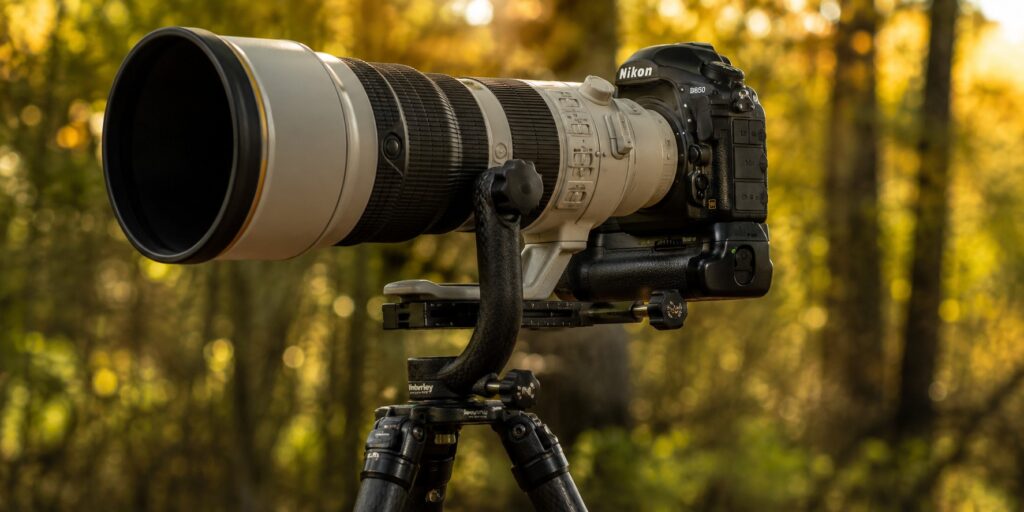
- Wildlife and Sports Photography: While traditionally the domain of lower-resolution, faster cameras like the Nikon D5 or D6, the D850 holds its own. The ability to shoot at 7 fps (or 9 fps with the battery grip) combined with the extreme cropping flexibility means you can put “pixels on the bird” even if you are focal-length limited.
- Macro Photography: The camera features a built-in Focus Shift Shooting mode, which automatically takes a sequence of up to 300 images while slightly shifting the focus point. These can be stacked in third-party software to create macro images with infinite depth of field.
The Reality of 45.7MP: Cropping Flexibility vs. Storage
Having nearly 46 megapixels is a double-edged sword. On the positive side, the cropping flexibility is immense. You can shoot a subject loosely, decide later in post-production that you want a tight vertical portrait from a horizontal frame, crop away 60% of the image, and still have a file large enough to print at high quality. You also have access to a DX-crop mode (APS-C size), which yields roughly 19.4 megapixel files while providing a 1.5x reach advantage.
The downside, heavily felt even in 2026, is the storage burden. Uncompressed 14-bit RAW files can easily exceed 90MB each. If you shoot a wedding and come home with 4,000 photos, you are looking at nearly 400GB of data from a single day. This necessitates fast, expensive memory cards, massive high-speed external SSDs, and powerful computer processors to edit the files smoothly.
Nikon D850 review Autofocus, Speed, Video, Battery, and Features
The 153-Point Autofocus System
The Nikon D850 inherited its phase-detection autofocus system directly from the flagship sports camera, the Nikon D5. The Multi-CAM 20K AF module features 153 focus points, 99 of which are the highly accurate cross-type sensors. The center point is sensitive down to an incredible -4 EV, allowing the camera to lock focus in near-total darkness, while the remaining points are sensitive to -3 EV.
Through the optical viewfinder, this AF system remains extraordinarily capable in 2026. For static subjects, it is instantly decisive. For moving subjects, Nikon’s 3D-Tracking algorithm, backed by a 180,000-pixel RGB metering sensor, does an excellent job of understanding subject color and maintaining focus on erratic movement across the frame.
However, we must be brutally honest regarding the 2026 context. Through the viewfinder, the AF points are clustered somewhat toward the center of the frame; they do not cover edge-to-edge like modern mirrorless cameras. Furthermore, the D850 lacks the AI-driven deep-learning subject recognition found on a Nikon Z8 or Sony A7 IV. There is no automatic “Animal Eye AF” or “Vehicle Tracking.” You, the photographer, must place the AF point over your subject’s eye and maintain it there. For seasoned professionals, this is second nature. For users accustomed to modern mirrorless automation, the D850 will feel demanding and archaic.
Live View Autofocus: The Achilles’ Heel
If the viewfinder AF is excellent, the Live View AF is the D850’s greatest weakness. Unlike Canon’s Dual Pixel CMOS AF or the phase-detect sensors on modern mirrorless sensors, the D850 relies solely on contrast-detection autofocus when the mirror is locked up in Live View or video mode. This results in slow, pulsing, hunting autofocus behavior. It is perfectly fine for static macro or landscape work on a tripod, but it is utterly useless for tracking moving subjects in Live View or relying on continuous video autofocus.
Speed, Buffer, and the 9 fps Grip Configuration
By default, the D850 shoots at a highly respectable 7 frames per second (fps) at full 45.7MP resolution with continuous autofocus. This was a remarkable engineering feat at launch. However, Nikon offered a legendary upgrade path. If you attach the optional MB-D18 battery grip and insert the larger EN-EL18b/c battery (the battery used in the D5/D6), the camera’s internal voltage increases, boosting the continuous shooting speed to a blistering 9 fps.
The buffer performance is equally impressive. When utilizing high-speed XQD or modern CFexpress Type B memory cards, the D850 can buffer up to 51 lossless compressed 14-bit RAW files before slowing down. In 2026, while 9 fps pales in comparison to the 20-30 fps electronic bursts of the Z8, it is more than enough for 95% of real-world action, sports, and wildlife photography.
Nikon D850 review Video Capabilities: 4K UHD and Limitations
The D850 was the first Nikon DSLR to shoot full-frame 4K UHD video (3840×2160) at 30, 25, and 24p without applying a crop factor, utilizing the full width of the sensor. It also offers Full HD 1080p at up to 120 fps for excellent slow-motion capture. The video quality is sharp, the colors are beautiful, and it offers uncompressed 4:2:2 8-bit output via HDMI.
However, as a hybrid video camera in 2026, it is entirely outclassed. It lacks 10-bit internal recording, Log profiles (N-Log is only available externally on this body), in-body image stabilization (IBIS), and, most critically, reliable video autofocus. If you are shooting video on a D850 today, you must pull focus manually. For cinematic, locked-down tripod work, the footage holds up beautifully. For vlogging or run-and-gun documentary filmmaking, you should buy a mirrorless camera.
Nikon D850 review Battery Performance and Connectivity
Battery life is where the D850 absolutely humiliates modern mirrorless competition. Powered by the EN-EL15a/b/c series battery, the camera is CIPA-rated for an astonishing 1,840 shots per charge. In real-world practical use, if you are shooting bursts and limiting your rear LCD review time, you can easily exceed 3,000 images on a single battery. With the MB-D18 grip and EN-EL18 battery, the rating jumps to over 5,140 shots. You can photograph an entire three-day wedding weekend without ever touching a charger.
Connectivity includes Nikon’s SnapBridge via Bluetooth Low Energy and Wi-Fi, allowing for image transfers to smartphones. Dual card slots are provided: one XQD slot (which, via firmware updates, supports blazing-fast CFexpress Type B cards) and one UHS-II SD card slot.
Nikon D850 review Price, Competition, and Buying Advice
The Current Market: Nikon D850 Price in 2026
Because the Nikon D850 is a mature, older DSLR platform (having ceased active new manufacturing output runs heavily around 2021/2022), the pricing landscape in 2026 is highly segmented between lingering “New Old Stock,” official refurbished units, and a massive, thriving used market. We have verified current 2026 pricing across major global regions to help you understand its true value proposition today.
| Region | Approximate Price | Condition / Market | Availability & Notes |
|---|---|---|---|
| USA | $1,996.95 USD | New (Body Only) | Available at major retailers (B&H, Adorama). Stabilized price. |
| USA | $1,599.96 USD | Nikon Refurbished | Direct from Nikon USA when in stock. 90-day warranty. |
| USA | $1,019 – $1,699 USD | Used (Varies by Shutter Count) | Widely available via MPB, KEH. $1,019 reflects heavily used condition. |
| UK | £2,399 GBP | New (Official Retail) | Official authorized dealers. Supply is occasionally limited. |
| India | ~₹2,34,950 INR | New (Official MRP baseline) | Prices fluctuate wildly. Kits w/ 24-120mm hover ~₹2,54,345 to ₹2,64,491. |
| India | ~₹1,51,399 INR | Used / Deal / Refurbished | Available via second-hand dealers or local camera markets. |
| Europe | €2,200 – €2,400 EUR | New | Varies significantly by country VAT. |
| Europe | €1,200 – €1,500 EUR | Used | Abundant on MPB Europe. Excellent value for money. |
*Note: Camera prices and availability are fluid and subject to change based on retailer stock and global exchange rates. Used prices depend heavily on shutter actuations and cosmetic condition.
The True Cost: F-Mount vs. Z-Mount Lenses
A major consideration for buying a D850 in 2026 is the lens ecosystem. The Nikon F-mount is technically a discontinued development line; Nikon is focusing entirely on the mirrorless Z-mount. However, this is secretly the greatest advantage for budget-conscious professionals. The used market is currently flooded with phenomenal F-mount lenses—such as the AF-S 14-24mm f/2.8G, 24-70mm f/2.8E VR, and legendary prime lenses—selling for half or even a third of their original MSRP. If you buy a used D850 for $1,200 and invest another $1,500 in top-tier used F-mount glass, you have a world-class professional kit for the price of a single new mirrorless camera body.
Competition: D850 vs. Modern Mirrorless Alternatives
To determine if the Nikon D850 is worth buying, we must conceptualize it against its 2026 rivals:
- Nikon Z8: The Z8 is the spiritual successor to the D850. It features a 45.7MP stacked sensor, entirely blackout-free EVF shooting, AI autofocus, and 8K video. It is vastly superior technologically, but it costs significantly more ($3,999+ USD), requires more expensive Z-mount lenses (unless you adapt F-mount lenses via the FTZ adapter), and has dramatically shorter battery life.
- Nikon Z7 II: Offering a similar 45.7MP BSI sensor to the D850, the Z7 II provides the same image quality in a lighter mirrorless body with IBIS. However, its ergonomics are smaller, and many pros still prefer the D850’s robust grip, optical viewfinder, and battery life for rugged outdoor work.
- Sony A7 IV / Canon EOS R5: The Sony A7 IV (33MP) is a far superior hybrid camera for video and AI autofocus. The Canon R5 (45MP) matches the resolution but offers tremendous video specs and IBIS. Choose these if you shoot equal parts video and stills, or if you rely heavily on eye-tracking autofocus for moving subjects.
Who Should Buy the Nikon D850 in 2026?
You should buy the Nikon D850 if you are a purist who explicitly wants the optical viewfinder experience. It is for the landscape photographer who demands immense resolution, 14.8 stops of dynamic range, and weather sealing that survives monsoons. It is for the studio portrait photographer who needs flawless tethering and strobe compatibility. Most importantly, it is for the pragmatic buyer who recognizes that a $1,200-$1,500 used D850 combined with cheap, professional F-mount glass represents the absolute best image-quality-to-dollar ratio in the entire photography industry today.
Final Verdict, Pros, Cons, and FAQs
The Pros
- Excellent 45.7MP image quality with no low-pass filter
- Strong dynamic range (~14.8 stops at base ISO 64)
- Excellent, tank-like magnesium alloy build quality and weather sealing
- Bright, zero-lag optical viewfinder with 100% coverage
- Huge F-mount lens ecosystem available cheaply on the used market
- Incredible battery performance (1,840+ shots per charge)
- Illuminated buttons and fantastic professional ergonomics
- Excellent still photography capabilities with deeply malleable RAW files
The Cons
- Large, bulky, and heavy compared with modern mirrorless bodies
- Older DSLR platform; Live View contrast-detect AF is dated and slow
- Video capabilities are completely behind newer hybrid cameras (no IBIS, no usable video AF)
- F-mount is no longer Nikon’s newest system; future lens development is dead
- New stock can sometimes be difficult to find depending on the region
- No modern AI computational subject-tracking algorithms
Rating Breakdown
Frequently Asked Questions (FAQs)
Is the Nikon D850 still worth buying in 2026?
Yes, absolutely. If your primary focus is high-resolution still photography (landscapes, studio, portraits) and you want incredible battery life and a rugged build at a fraction of the cost of a modern flagship mirrorless camera, the D850 is a spectacular buy on the used or refurbished market.
How many megapixels does the Nikon D850 have?
The Nikon D850 features a 45.7-megapixel full-frame FX-format BSI CMOS sensor without an optical low-pass filter, delivering stunning detail and resolution.
Is the Nikon D850 good for professional photography?
Yes. The D850 was built specifically for working professionals. Its weather sealing, dual card slots (XQD/CFexpress and SD), tethering capabilities, and robust F-mount ecosystem make it highly reliable for paid client work.
Should I buy a Nikon D850 or Nikon Z8?
If budget is no object, you shoot a lot of video, and you want cutting-edge AI autofocus for moving subjects, buy the Nikon Z8. If you are on a budget, shoot primarily stills, prefer an optical viewfinder, and want to utilize cheap F-mount lenses, buy the Nikon D850.
In conclusion, this Nikon D850 review proves that true quality is timeless. While the industry has firmly transitioned to mirrorless technology, the D850’s unparalleled battery life, immense 45.7MP resolution, and mechanical reliability cement its legacy. Whether you are a professional upgrading your secondary body or an enthusiast capitalizing on the incredible value of used DSLRs in 2026, the Nikon D850 remains one of the greatest cameras ever manufactured.