

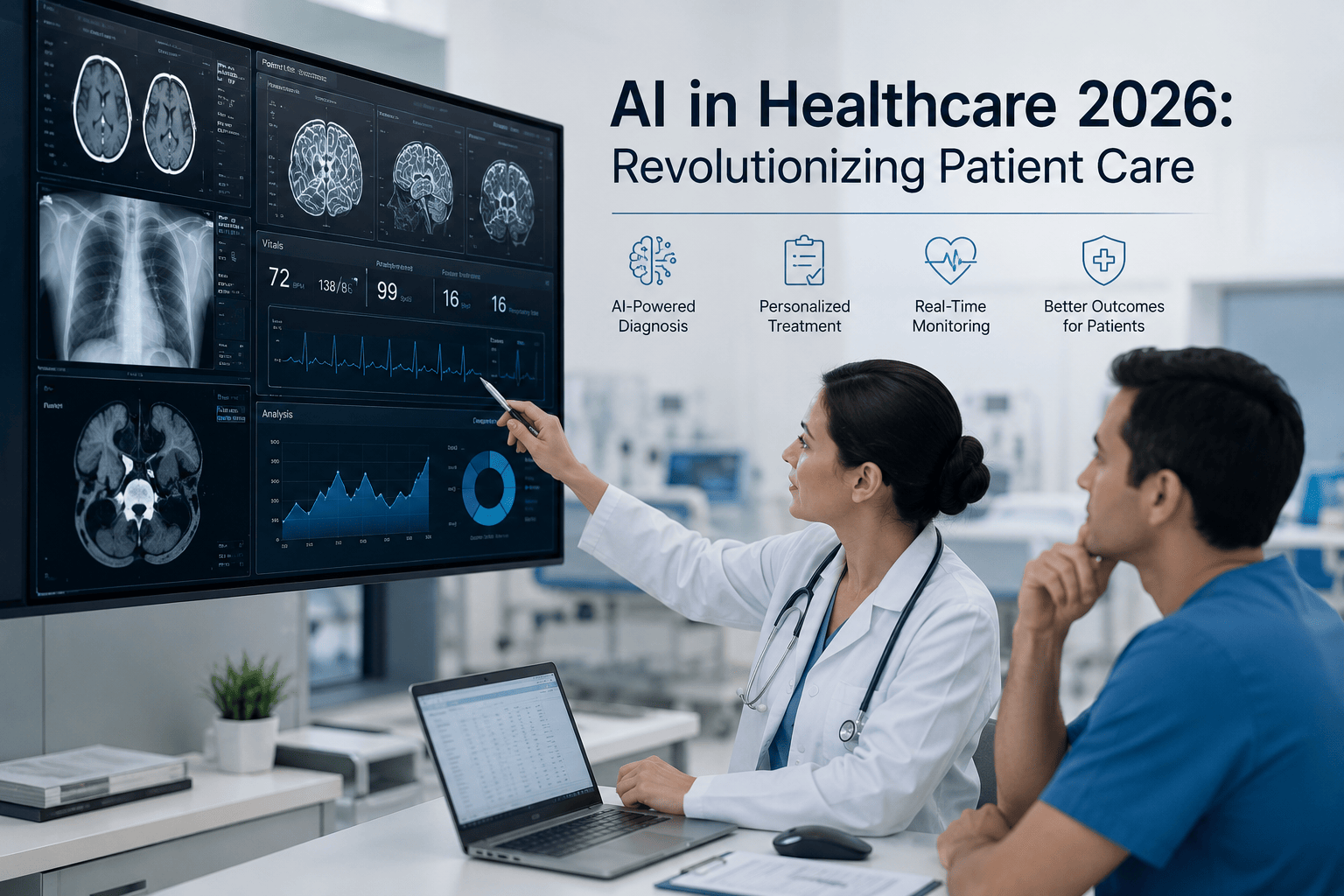

Artificial intelligence is fundamentally transforming healthcare in ways that were considered science fiction just a few years ago. From early disease detection to personalized treatment plans, AI systems are becoming indispensable tools in the medical field. The integration of AI into healthcare is not replacing physicians but augmenting their capabilities, enabling better outcomes and more efficient care delivery.
AI-Powered Diagnostics
Deep learning algorithms can now analyze medical images with accuracy that matches or exceeds trained radiologists. A landmark study in The Lancet Digital Health found that AI achieved 94.5% accuracy in detecting lung cancer from CT scans, compared to 88.2% for human radiologists. This level of accuracy represents a significant advancement in diagnostic capabilities and has profound implications for early disease detection.
AI diagnostic systems excel at pattern recognition across multiple medical imaging modalities. In mammography, AI systems have demonstrated the ability to reduce false positives by up to 5.7%, meaning fewer unnecessary biopsies and less patient anxiety. For retinal imaging, AI can detect diabetic retinopathy with over 90% sensitivity, enabling early intervention that can prevent vision loss.
The real power of AI diagnostics lies in their consistency and availability. Unlike human radiologists who may experience fatigue or varying levels of expertise, AI systems provide consistent analysis 24/7. This is particularly valuable in underserved areas where access to specialist radiologists is limited. AI-powered diagnostic tools can provide preliminary readings in minutes, enabling faster clinical decision-making.
Google’s Med-PaLM 2 and similar large language models trained on medical knowledge are showing remarkable capabilities in clinical reasoning. These systems can analyze patient symptoms, medical history, and diagnostic data to suggest potential diagnoses and treatment approaches. While they are not intended to replace clinical judgment, they serve as powerful decision support tools that can help clinicians consider a broader range of possibilities.
Drug Discovery Revolution
AI-powered platforms are revolutionizing the drug discovery process, which traditionally takes 10-15 years and costs over $2 billion per approved drug. AI can screen millions of potential drug compounds in silico, identifying promising candidates in days rather than years. Insilico Medicine’s discovery of a new drug candidate for pulmonary fibrosis in just 18 months demonstrates the transformative potential of AI in pharmaceutical research.
The drug discovery process benefits from AI at multiple stages. Target identification uses AI to analyze genomic and proteomic data to identify disease-related biological targets. Lead optimization employs machine learning to predict how modifications to chemical compounds will affect their efficacy and safety. Clinical trial design uses AI to optimize patient selection, dosing regimens, and endpoint selection.
AlphaFold’s revolutionary protein structure prediction has opened new frontiers in drug design. With AI predicting the 3D structures of virtually all known proteins, researchers can now design drugs that precisely target specific molecular configurations. This structural biology breakthrough has the potential to dramatically accelerate the development of targeted therapies for diseases ranging from cancer to neurodegenerative disorders.
Personalized Medicine
AI enables truly personalized medicine by analyzing a patient’s genetic profile, lifestyle factors, and medical history to tailor treatment approaches. This represents a paradigm shift from the traditional one-size-fits-all approach to medicine, where treatments are designed for the average patient rather than the individual.
Pharmacogenomics powered by AI can predict how individual patients will respond to specific medications, enabling clinicians to select the most effective drugs and optimal dosages from the start. This reduces adverse drug reactions, which account for approximately 5% of hospital admissions annually, and improves treatment outcomes.
AI-powered insulin pumps continuously monitor blood glucose levels and adjust insulin delivery automatically, providing unprecedented precision in diabetes management. These closed-loop systems, often called “artificial pancreas” devices, have demonstrated significant improvements in glycemic control and quality of life for patients with type 1 diabetes.
Cancer treatment has been particularly transformed by AI-driven personalization. AI algorithms analyze tumor genomic data to identify specific mutations and recommend targeted therapies. Memorial Sloan Kettering’s AI system can match cancer patients with optimal clinical trials based on their tumor profiles, potentially providing access to cutting-edge treatments that might otherwise be overlooked.
Clinical Operations and Efficiency
AI is streamlining clinical operations, reducing administrative burden, and improving efficiency. Natural language processing systems can transcribe and summarize patient encounters in real-time, reducing the documentation burden that contributes to physician burnout. Ambient AI scribes are being deployed in hospitals and clinics, automatically generating clinical notes from physician-patient conversations.
Predictive analytics powered by AI can forecast patient admission volumes, enabling hospitals to optimize staffing and resource allocation. These systems analyze historical patterns, seasonal trends, and current events to provide accurate predictions that help prevent overcrowding and ensure adequate staffing levels.
AI-powered triage systems can assess patient symptoms and acuity levels, helping emergency departments prioritize care delivery. These systems analyze vital signs, symptoms, and medical history to assign appropriate triage levels, reducing wait times for critical patients and improving overall department efficiency.
Challenges and Ethical Considerations
Data privacy remains a critical concern as AI systems require access to large volumes of patient data for training and operation. Healthcare organizations must ensure compliance with HIPAA, GDPR, and other privacy regulations while maintaining the data access necessary for AI development. Techniques like federated learning, which enables AI training across distributed datasets without centralizing patient data, offer promising solutions.
Algorithmic bias in healthcare AI has the potential to exacerbate existing health disparities. If AI systems are trained on datasets that underrepresent certain populations, they may provide less accurate diagnoses or treatment recommendations for those groups. Ensuring diverse and representative training datasets is essential for equitable AI deployment.
Regulatory frameworks for healthcare AI are evolving rapidly. The FDA has approved over 500 AI-enabled medical devices, but clear guidelines for continuously learning AI systems remain under development. Organizations deploying AI in clinical settings must navigate complex regulatory requirements while maintaining the agility to innovate.
The integration of AI into clinical workflows requires careful change management. Clinicians need training to effectively use AI tools and understand their limitations. Over-reliance on AI recommendations without critical evaluation poses risks, as does dismissing AI insights that could improve patient care. Finding the right balance between human judgment and AI assistance is an ongoing challenge.
The Future of AI in Healthcare
The convergence of AI with other emerging technologies promises even more transformative changes. AI-powered digital twins can simulate patient physiology to predict treatment outcomes before interventions are performed. Federated learning networks will enable hospitals to collaborate on AI development while preserving patient privacy. Multimodal AI systems that integrate imaging, genomics, clinical notes, and wearable device data will provide holistic patient assessments.
As AI continues to mature, its role in healthcare will expand from decision support to increasingly autonomous systems. While fully autonomous medical AI remains distant, the progressive delegation of routine tasks to AI systems will free clinicians to focus on the uniquely human aspects of medicine: empathy, complex decision-making, and patient relationships.