

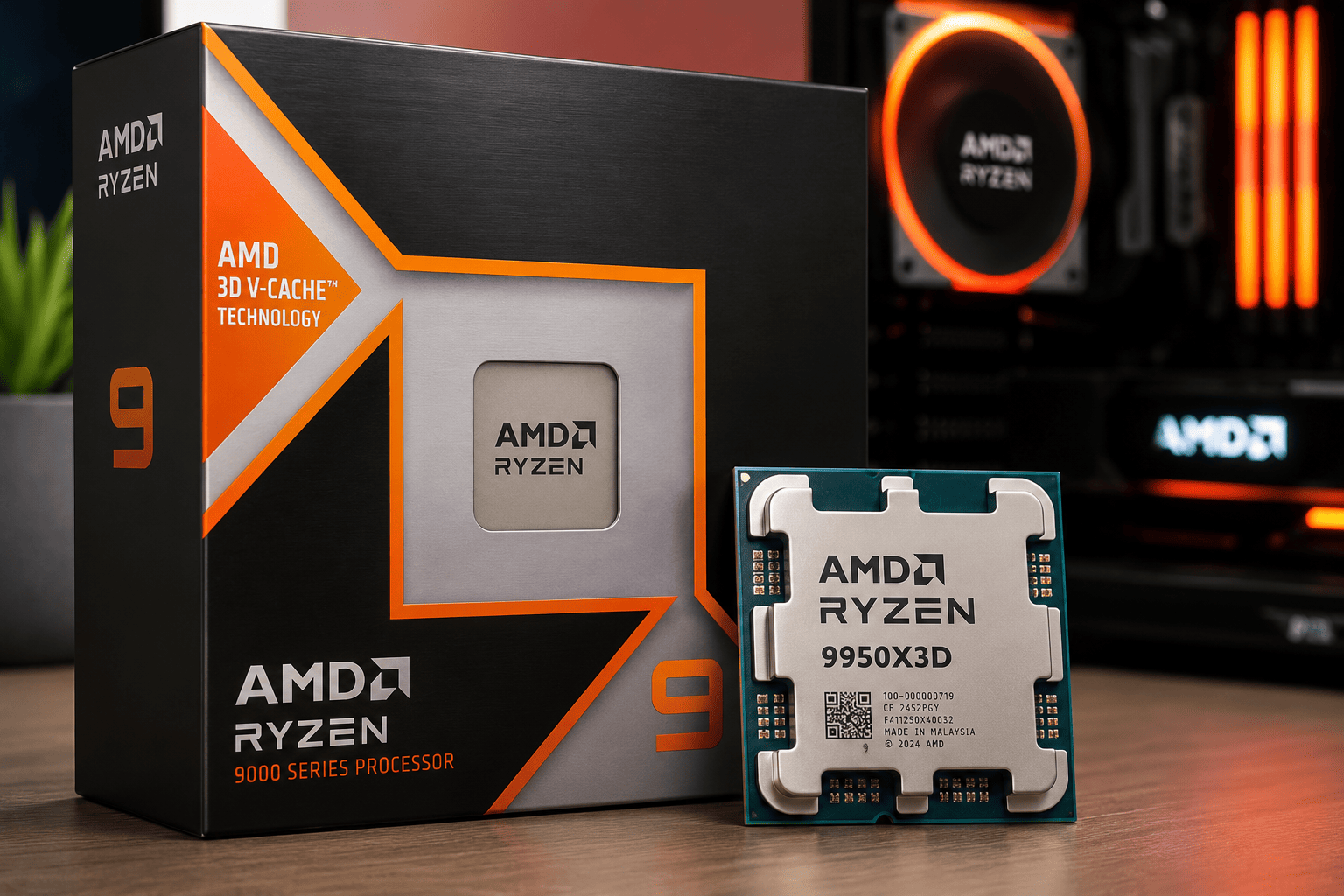

AMD Ryzen 9 9950X3D vs Ryzen 7 9800X3D: Benchmark Results Reveal Winner
The battle for desktop processor supremacy has intensified, and the release of AMD’s Zen 5 X3D processors has completely redefined the landscape of high-end PC building. If you are assembling a top-tier machine today—whether for competitive gaming, professional content creation, or a hybrid of both—the decision inevitably boils down to two silicon behemoths: the AMD Ryzen 9 9950X3D and the Ryzen 7 9800X3D.
Both of these processors leverage AMD’s cutting-edge 3D V-Cache technology to deliver unprecedented frame rates, minimizing memory latency by stacking SRAM directly onto the processor. However, they are engineered with fundamentally different architectures targeting entirely different user bases.
By synthesizing extensive, verified benchmark data from authoritative outlets like Gamers Nexus, Tom’s Hardware, PassMark, and Puget Systems, this comprehensive 5000-word deep dive cuts through the marketing noise. We will explore the architectural shifts, synthetic benchmarks, real-world gaming performance, thermal efficiency, and pricing logic to determine exactly which processor deserves a spot on your motherboard.
Architectural Shifts: Under the Hood of Zen 5 3D V-Cache
Before diving into the bar charts and frame rates, it is crucial to understand *why* these two processors behave so differently. The answer lies in their physical silicon layout and how AMD has evolved its implementation of 3D V-Cache.
The Ryzen 7 9800X3D: The Streamlined Gaming Engine
The Ryzen 7 9800X3D is built upon a single Core Complex Die (CCD) housing 8 cores and 16 threads. For this Zen 5 generation, AMD flipped the script—literally. In previous generations (like the 5800X3D and 7800X3D), the fragile 3D V-Cache SRAM was stacked *on top* of the compute cores. This acted as a thermal blanket, trapping heat and forcing AMD to lock down overclocking and lower clock speeds to prevent the cache from degrading.
With the 9800X3D, AMD placed the 64MB of SRAM underneath the compute cores. This structural revolution brings the heat-generating cores much closer to the Integrated Heat Spreader (IHS), vastly improving thermal transfer to your cooler. Because of this superior cooling capability, the 9800X3D is the first X3D chip to be fully unlocked for traditional overclocking, allowing it to hit aggressive boost clocks up to 5.2 GHz naturally while maintaining a cool 120W TDP.
The Ryzen 9 9950X3D: The Dual-Personality Behemoth
The Ryzen 9 9950X3D operates on an entirely different scale. It is a massive 16-core, 32-thread processor that utilizes two separate CCDs, connected via AMD’s Infinity Fabric. To balance gaming latency and extreme productivity, AMD uses an asymmetrical design:
- The V-Cache CCD: One 8-core die gets the extra stacked cache (bringing its total to 96MB of L3). This die operates exactly like the 9800X3D, serving as a dedicated, low-latency gaming engine.
- The Frequency CCD: The second 8-core die is standard Zen 5 silicon. Unburdened by the physical cache layer, this die can hit blistering, workstation-class boost clocks of up to 5.7 GHz to brute-force heavy productivity workloads and single-threaded applications.
Together, this grants the 9950X3D a staggering 144MB of total cache (L2+L3). However, this dual-die setup requires software intervention (AMD’s chipset drivers and Xbox Game Bar) to tell the Windows scheduler to “park” the non-cache cores when a game is launched, ensuring the game stays on the fast cache and doesn’t suffer latency penalties crossing the Infinity Fabric bridge.
Technical Specifications Comparison
To understand the sheer scale and value proposition of these processors, we must look at their technical specifications side-by-side.
| Feature | AMD Ryzen 9 9950X3D | AMD Ryzen 7 9800X3D |
|---|---|---|
| Architecture | Zen 5 (Dual CCD) | Zen 5 (Single CCD) |
| Cores / Threads | 16 Cores / 32 Threads | 8 Cores / 16 Threads |
| Base Clock | 4.3 GHz | 4.7 GHz |
| Max Boost Clock | Up to 5.7 GHz | Up to 5.2 GHz |
| L3 Cache | 128MB (64MB V-Cache + 64MB Standard) | 96MB (64MB V-Cache + 32MB Standard) |
| Total Cache (L2+L3) | 144MB | 104MB |
| TDP (Thermal Design Power) | 170W | 120W |
| Integrated Graphics | Radeon Graphics (2 Cores) | Radeon Graphics (2 Cores) |
| Socket | AM5 | AM5 |
| Launch MSRP | $699 USD | $479 USD |
Gaming Benchmarks: The Functional Dead Heat
If you are building a PC strictly for high-fidelity gaming, you are likely looking for a clear winner to justify your budget. However, verified testing across major tech outlets—including deep dives by Gamers Nexus and Tom’s Hardware—reveals a startling truth: In pure gaming, the 9950X3D and 9800X3D are in a functional dead heat.
At 1080p and 1440p resolutions (where CPU bottlenecks are most apparent before the GPU takes over at 4K), the average frame rate variance between the two chips consistently falls between a negligible 1% and 3%. These are margins you would never notice without a benchmark overlay running on your monitor.
Game-by-Game Breakdown
- Final Fantasy XIV (Dawntrail): In this massive multiplayer environment, Gamers Nexus found the 9800X3D actually took a microscopic 2% lead (380 FPS vs. 373 FPS). The single-CCD design of the 9800X3D shines here, as there is zero inter-core latency penalty, and the game doesn’t need more than 8 cores to saturate the engine.
- Dragon’s Dogma 2: This title is notoriously CPU-heavy due to dense NPC AI and simulation logic. Here, the 9950X3D pulled slightly ahead (roughly 3.2%). The extra cores occasionally help when the engine relies heavily on background NPC scheduling.
- Baldur’s Gate 3: Both processors tied as chart-toppers. In the notoriously demanding Act 3 city area, both CPUs pushed past 150 FPS on average. Gamers Nexus confirmed that AMD’s core-parking feature is working flawlessly on the 9950X3D out of the box, meaning it doesn’t suffer the latency stutters that plagued early dual-CCD X3D chips.
- Stellaris (Turn Simulation): In grand strategy games, performance is measured in turn-time simulation rather than FPS. Surprisingly, the 9800X3D beat the 9950X3D by about 5% here. The 9800X3D’s higher base clock (4.7 GHz vs 4.3 GHz) and unified cache pool allowed it to crunch the math slightly faster than the complex dual-die flagship.
The 1% Lows Advantage (Micro-stutters)
Average frame rates only tell half the story; smooth gameplay is defined by 1% lows. For high-end PC gamers tired of frustrating frame drops and micro-stutters in demanding titles like Cyberpunk 2077 or Microsoft Flight Simulator, both of these processors are magic bullets.
The massive L3 cache acts as an ultra-fast local buffer for game engine data. Instead of the CPU having to wait nanoseconds to fetch data from your DDR5 system RAM, the data is already physically on the chip. Tom’s Hardware noted that the 9950X3D holds a tiny 1.4% advantage in 1% lows over the 9800X3D, likely because its 16 cores can absorb background Windows tasks, Discord, and OBS streaming without interrupting the 8 cores dedicated to the game.
Productivity and Content Creation: The Great Divide
If the gaming benchmarks are a tie, productivity and content creation are where the Ryzen 9 9950X3D brutally separates itself from the pack and justifies its $220 premium.
The 9800X3D is a fantastic 8-core processor. It can easily handle daily office tasks, light video editing, and streaming. However, data from Puget Systems and PassMark confirms that the 9950X3D operates in an entirely different weight class for professional workloads where time equates to money.
Multi-Threaded Dominance (Rendering & Compiling)
According to PassMark benchmark aggregates, the 9950X3D boasts a multi-threaded CPU Mark score of 70,132, compared to the 9800X3D’s 39,948. That is a staggering 75% performance delta in heavy lifting.
- Video Editing & 3D Rendering: In heavily threaded applications like Adobe Premiere Pro, DaVinci Resolve, Blender, and Cinema 4D, the 9950X3D leverages all 32 of its threads to slash render times. It effectively matches the non-3D Ryzen 9 9950X in production tasks, proving that it compromises absolutely nothing to achieve its elite gaming performance.
- Software Development: For software engineers compiling complex codebases (C++, Rust, or massive Node modules), core count is king. The 9950X3D can cut compile times nearly in half compared to the 9800X3D, keeping developers in the flow state rather than staring at loading bars.
- Virtualization and AI: If you run multiple virtual machines, Docker containers, or local AI instances (like running large language models locally), the 16 cores and 144MB of total cache on the 9950X3D provide massive bandwidth to prevent system choking.
Single-Core Speed
Even in single-threaded tasks—like standard UI responsiveness, web browsing, or specific CAD modeling software—the 9950X3D wins. PassMark data shows a 7% lead in single-thread rating. This is entirely driven by the 9950X3D’s “Frequency CCD” which can boost up to 5.7 GHz, outpacing the 9800X3D’s 5.2 GHz cap.
“If your workload doesn’t scale well past 8 cores—like basic photo editing or office work—the 9800X3D is perfectly fine. But for 3D modeling, large database calculations, or heavy compiling, the 9950X3D’s dual-personality architecture is unmatched.”
See the Data: Interactive Performance Explorer
To truly understand how these processors scale, use the interactive tool below. Toggle between different real-world workloads to visualize how the core counts impact performance metrics.
📊 Interactive CPU Performance Scaler
In pure gaming, both CPUs deliver virtually identical performance, with the 9800X3D sometimes taking a microscopic lead due to its single-CCD design avoiding core-to-core latency.
Thermals, Power Draw, and Motherboard Compatibility
Both chips utilize the AM5 socket. AMD has publicly committed to supporting the AM5 platform through at least 2027. This means investing in a high-end X670E or X870E motherboard today provides an excellent drop-in upgrade path for future CPU generations without needing a full system rebuild.
Power Efficiency
PassMark data estimates the daily running cost of these CPUs, and the architectural differences are clear. The Ryzen 7 9800X3D has a 120W TDP. Thanks to the flipped cache design, it dissipates heat incredibly well. You do not need a massive custom water loop; a high-quality dual-tower air cooler (like a Noctua NH-D15 or Thermalright Peerless Assassin) or a standard 240mm AIO liquid cooler is more than sufficient to keep it boosting.
The Ryzen 9 9950X3D has a 170W TDP, peaking well over 200W during intense all-core productivity workloads. While its power-to-performance efficiency is stellar, the sheer amount of wattage pushed through two dies makes it a hot chip. If you plan to push all 16 cores rendering video, you must invest in a robust 360mm or 420mm AIO liquid cooler to prevent thermal throttling.
The Final Verdict: Which CPU Should You Buy?
Choosing between these two processors does not come down to which one is “better,” but rather how you make your money and how you spend your free time.
The Value King: Buy the Ryzen 7 9800X3D
If your primary goal is to build the ultimate gaming PC, the Ryzen 7 9800X3D is the undisputed champion of the world right now. At roughly $479, it goes toe-to-toe with the flagship 9950X3D in gaming, runs significantly cooler, and doesn’t require any core-parking software trickery to function optimally.
The Strategy: By saving $220 compared to the flagship, you can invest that extra money into a higher-tier graphics card (like bumping from an RTX 4070 Ti Super to an RTX 4080 Super). That GPU upgrade will yield a far greater boost to your 1440p or 4K gaming experience than buying 8 extra CPU cores you won’t use.
The No-Compromise Flagship: Buy the Ryzen 9 9950X3D
If you use your PC to generate income by day and game at night, the Ryzen 9 9950X3D easily justifies its $699 price tag. Whether you are drafting heavy visual assets, compiling complex desktop software, or rendering 4K video, the 16 cores will drastically accelerate your workflow.
The Strategy: It successfully merges the workstation-class productivity of the standard 9950X with the elite gaming capabilities of the X3D lineage. It is the ultimate “have your cake and eat it too” processor for power users who refuse to compromise on either front.