


NVIDIA RTX 4080 vs RTX 5080: Full Comparison, Benchmarks, Gaming Performance & Price
NVIDIA’s launch of the Blackwell-based RTX 5080 has sparked intense debate among PC enthusiasts. While it keeps the same $999 MSRP as the outgoing RTX 4080 Super, the new architectural upgrades and memory configurations make it a very different beast under the hood.
If you are weighing an upgrade or building a new high-end gaming PC in 2026, the choice between Ada Lovelace and Blackwell requires a closer look at the actual performance data rather than just the marketing spec sheet.
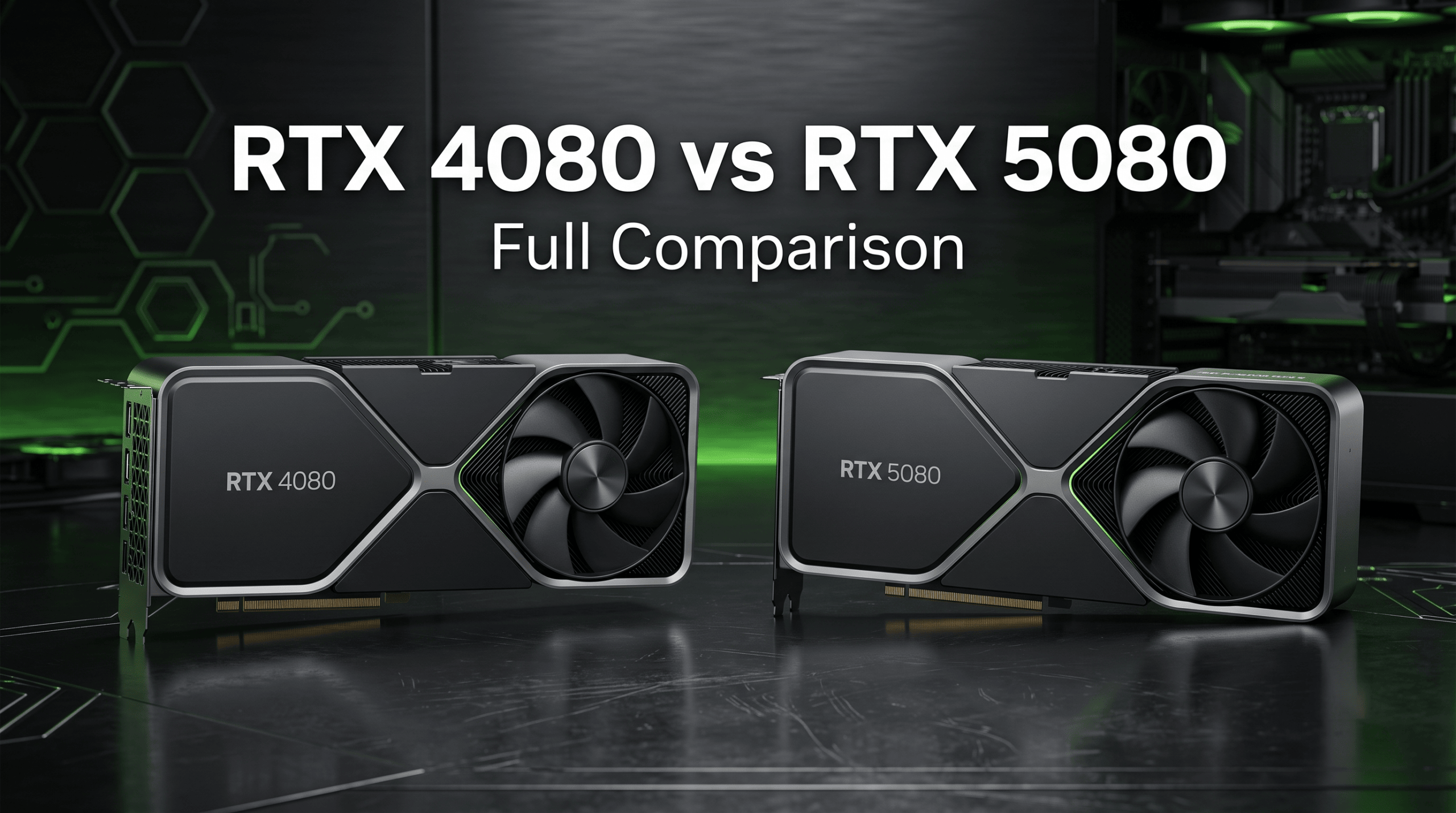
Here is a look at the newly minted RTX 5080 design:

Architectural Shifts: Blackwell vs. Ada Lovelace
At first glance, the RTX 5080 looks remarkably similar to the RTX 4080 Super, but NVIDIA has deliberately focused its upgrades on memory speed, ray tracing throughput, and AI processing rather than raw core counts.
The RTX 5080 moves to the new Blackwell architecture, swapping out the RTX 4080’s GDDR6X memory for the blazing-fast GDDR7 standard. This bumps the memory bandwidth from 737 GB/s up to 960 GB/s, which plays a massive role in high-resolution 4K gaming. Additionally, the new 5th-generation Tensor cores introduce hardware support for the FP4 AI format, effectively doubling the AI inference performance compared to the 4080.
Spec Comparison
| Feature | NVIDIA RTX 5080 | NVIDIA RTX 4080 Super |
|---|---|---|
| Architecture | Blackwell (5nm) | Ada Lovelace (5nm) |
| CUDA Cores | 10,752 | 10,240 |
| VRAM | 16GB GDDR7 | 16GB GDDR6X |
| Memory Bandwidth | 960 GB/s | 737 GB/s |
| Boost Clock | 2,617 MHz | 2,550 MHz |
| TDP (Power) | 360W | 320W |
| Launch MSRP | $999 | $999 |
🎮 Interactive GPU Performance Explorer
Select a game and resolution below to see how the RTX 5080 scales against the RTX 4080 Super.
173 FPS
152 FPS
The RTX 5080 is approximately 13.8% faster in this scenario.
Gaming Performance and Benchmarks
If you are gaming at 1440p, the generational leap is relatively muted. Across a suite of standard rasterized titles, the RTX 5080 averages about a 4% to 9% uplift over the RTX 4080 Super.
However, at 4K resolution (2160p), the narrative changes. The RTX 5080 consistently delivers double-digit gains, averaging a 14% to 20% lead over the 4080 Super.
- Cyberpunk 2077 (4K Max Settings): The 5080 pushes roughly 173 FPS compared to the 4080 Super’s 152 FPS.
- The Witcher 3 (RT On + DLSS): Reviewers note an impressive jump, with the 5080 hitting ~135 FPS versus the 4080 Super’s ~110 FPS, alongside noticeably lower latency.
The DLSS 4 and Multi-Frame Generation (MFG) Factor
Raw rasterization tells only half the story. The RTX 5080 utilizes NVIDIA’s newest DLSS 4 algorithms and Multi-Frame Generation (MFG) much more efficiently. In titles that heavily stress ray tracing (like Alan Wake 2 or Dying Light 2), the RTX 5080 can pull ahead by over 20%, offering significantly smoother frame pacing.
Power Draw and AI Capabilities
The RTX 5080 bumps the Total Board Power (TDP) up to 360W from the 4080’s 320W. Despite the higher ceiling, real-world testing shows excellent efficiency, with the 5080 often running cooler (around 65°C under load) and sometimes consuming less power than the 4080 Super in equivalent scenarios.
For AI enthusiasts, the Blackwell architecture is a massive selling point. With hardware support for FP4, the 5080 drastically outperforms the 4080 Super in local AI inference (like running Large Language Models or Stable Diffusion), generating tokens nearly 40% faster.
The Verdict: Which Should You Buy?
At $999, the RTX 5080 completely replaces the RTX 4080 Super in NVIDIA’s product stack.
- Buy the RTX 5080 if: You are building a new system for 4K gaming, you rely heavily on Ray Tracing, or you run local AI workloads. The inclusion of GDDR7 memory and DLSS 4 makes it the undisputed choice at the $1,000 mark.
- Stick with the RTX 4080 Super if: You already own one. The 10-15% average rasterization uplift is not worth spending another thousand dollars, especially since both cards are limited to 16GB of VRAM. Furthermore, if you can find a used or heavily discounted 4080 Super, it remains an incredibly potent 1440p/4K card today.