

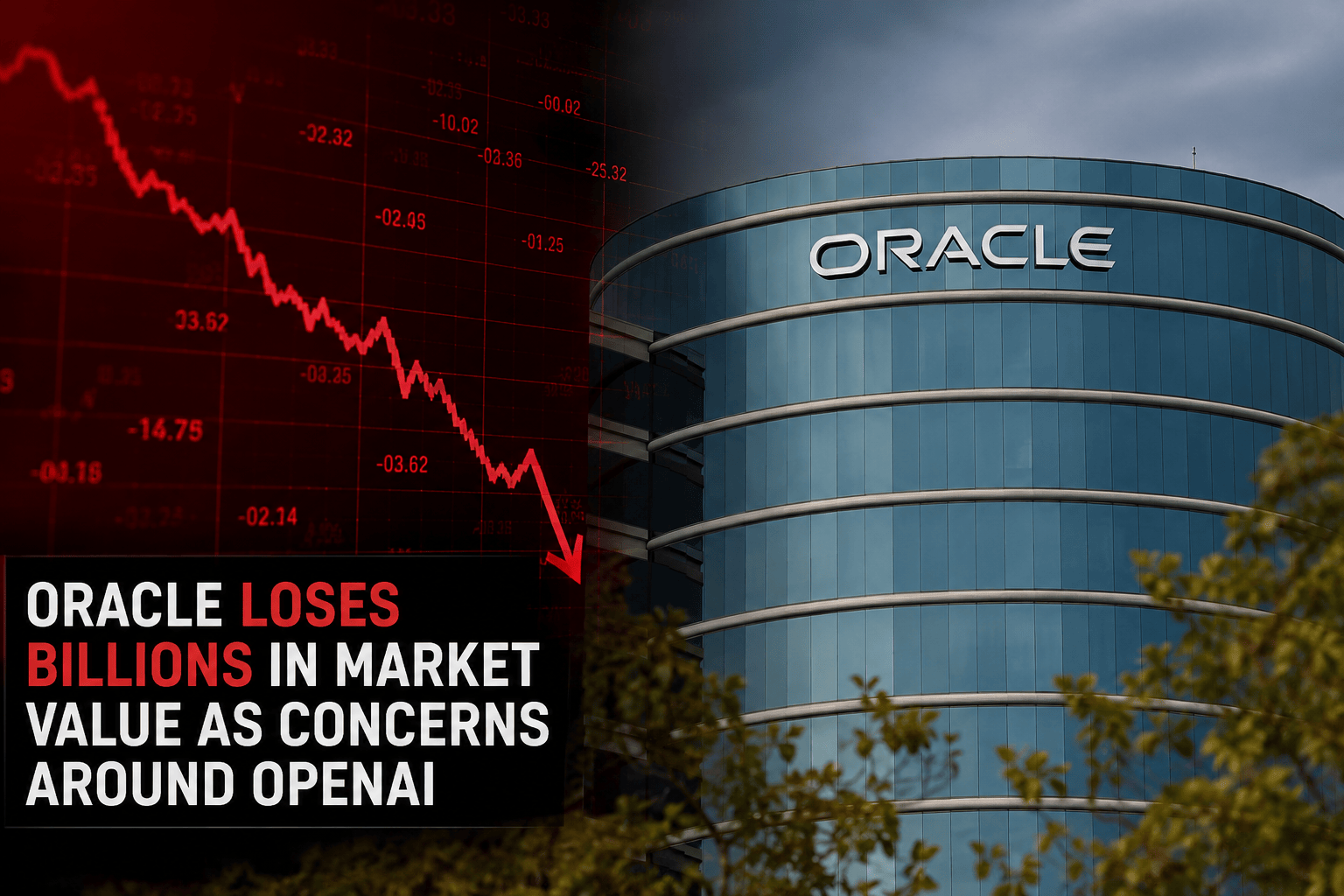

Oracle Loses Billions in Market Value as OpenAI Risks and Chinese AI Competition Shake Investor Confidence
The artificial intelligence boom has transformed Oracle into one of the world’s fastest-growing cloud infrastructure providers. However, the same AI revolution that fueled the company’s rapid growth is now creating fresh concerns among investors. Oracle recently suffered a significant decline in market value as Wall Street questioned the financial risks associated with its aggressive AI investments, heavy dependence on OpenAI, and the rapid rise of Chinese artificial intelligence companies.
The sell-off comes at a time when investors are becoming more cautious about whether the billions of dollars being poured into AI infrastructure will deliver the expected long-term returns.
Why Oracle’s Market Value Fell
Oracle has invested tens of billions of dollars to expand its cloud infrastructure business and become a leading provider of AI computing services. The company has signed major cloud agreements with OpenAI, providing the massive computing power needed to train and operate advanced AI models.
While these deals have positioned Oracle as a major player in the AI race, they have also increased the company’s financial exposure. Building AI-ready data centers requires enormous investments in servers, networking equipment, cooling systems, and electricity before any meaningful profits are realized.
Investors are now asking whether these massive upfront costs can be justified if AI demand slows or if customers reduce spending in the future.
OpenAI Partnership Raises Financial Concerns
One of the biggest reasons behind the recent decline is Oracle’s close relationship with OpenAI.
Industry analysts note that OpenAI represents a significant portion of Oracle’s future cloud business. This means Oracle’s financial performance is becoming increasingly dependent on the continued success and expansion of OpenAI.
If OpenAI changes its infrastructure strategy, delays expansion plans, or reduces cloud spending, Oracle could face slower revenue growth than investors currently expect.
Because of these concerns, credit rating agency S&P Global Ratings recently downgraded Oracle’s credit rating, citing higher debt levels and increased financial risk from the company’s aggressive AI infrastructure investments.
Although Oracle remains financially strong, the downgrade signals that investors should closely monitor the company’s growing capital expenditure and long-term debt.
Chinese AI Companies Are Changing the Market
Another factor affecting investor confidence is the rapid progress of Chinese AI developers.
Several Chinese technology companies have introduced powerful AI models that deliver competitive performance while requiring significantly lower computing costs. These lower-cost alternatives could reduce demand for expensive AI infrastructure, particularly if businesses begin adopting more efficient models.
Growing competition from China is forcing technology companies worldwide to rethink their AI strategies and could eventually impact spending on cloud infrastructure providers such as Oracle.
The increasing availability of open-source AI models is also creating additional pressure, as businesses now have more choices than ever before.
AI Infrastructure Spending Under the Spotlight
Oracle is not the only company facing investor scrutiny.
Technology giants across the industry—including cloud providers and semiconductor manufacturers—have committed hundreds of billions of dollars toward AI data centers and specialized hardware.
While demand for artificial intelligence continues to grow rapidly, investors now want evidence that these investments can generate sustainable profits rather than simply increasing revenue.
The AI industry is entering a new phase where profitability matters just as much as growth.
Oracle Still Has Strong Long-Term Potential
Despite the recent decline in market value, Oracle remains one of the strongest enterprise technology companies in the world.
Its Oracle Cloud Infrastructure (OCI) business continues to expand, enterprise software revenue remains stable, and long-term AI contracts provide a solid foundation for future growth.
The company is also benefiting from increasing demand for cloud computing, database services, cybersecurity, and enterprise AI solutions.
Many analysts believe Oracle could recover once investors gain more confidence that its AI investments are producing consistent financial returns.
What Investors Should Watch
Over the coming quarters, investors will closely monitor several key areas:
- Growth in Oracle Cloud Infrastructure (OCI)
- Revenue generated from AI-related cloud services
- Progress of OpenAI infrastructure projects
- Capital expenditure and debt levels
- Competition from Chinese AI companies
- Overall demand for enterprise AI services
Strong earnings and continued cloud growth could restore investor confidence, while slower AI adoption or higher-than-expected spending could create additional pressure on Oracle’s stock.
Final Thoughts
Oracle’s recent decline in market value highlights the changing mood on Wall Street. Investors are no longer focused solely on AI growth—they are now demanding proof that massive investments in artificial intelligence can translate into sustainable profits.
Oracle remains one of the most important companies in the AI infrastructure market, but its future performance will depend on balancing rapid expansion with financial discipline.
As competition intensifies and the AI landscape evolves, Oracle’s ability to execute its long-term strategy will play a critical role in determining whether it emerges as one of the biggest winners of the AI era.
Disclaimer: This article is based on publicly available reports and market developments. It is intended for informational purposes only and should not be considered financial or investment advice.
FAQ Section
Q1. Why did Oracle lose billions in market value?
Oracle’s market value declined because investors became concerned about the company’s heavy AI infrastructure spending, increasing debt, and dependence on OpenAI as a major cloud customer.
Q2. How is OpenAI affecting Oracle?
Oracle provides cloud infrastructure for OpenAI. Since OpenAI accounts for a significant portion of Oracle’s future AI cloud business, any slowdown in OpenAI’s expansion could impact Oracle’s revenue growth.
Q3. Why are Chinese AI companies a concern?
Chinese AI developers are releasing powerful AI models that require less computing power and lower operating costs, potentially reducing demand for expensive cloud infrastructure.
Q4. Is Oracle still a good long-term AI company?
Many analysts believe Oracle still has strong long-term growth potential due to its expanding cloud business, enterprise software leadership, and AI infrastructure investments.
Q5. What should investors watch next?
Investors should monitor Oracle’s cloud revenue, AI infrastructure profitability, OpenAI partnerships, capital spending, and competition from emerging AI companies.