

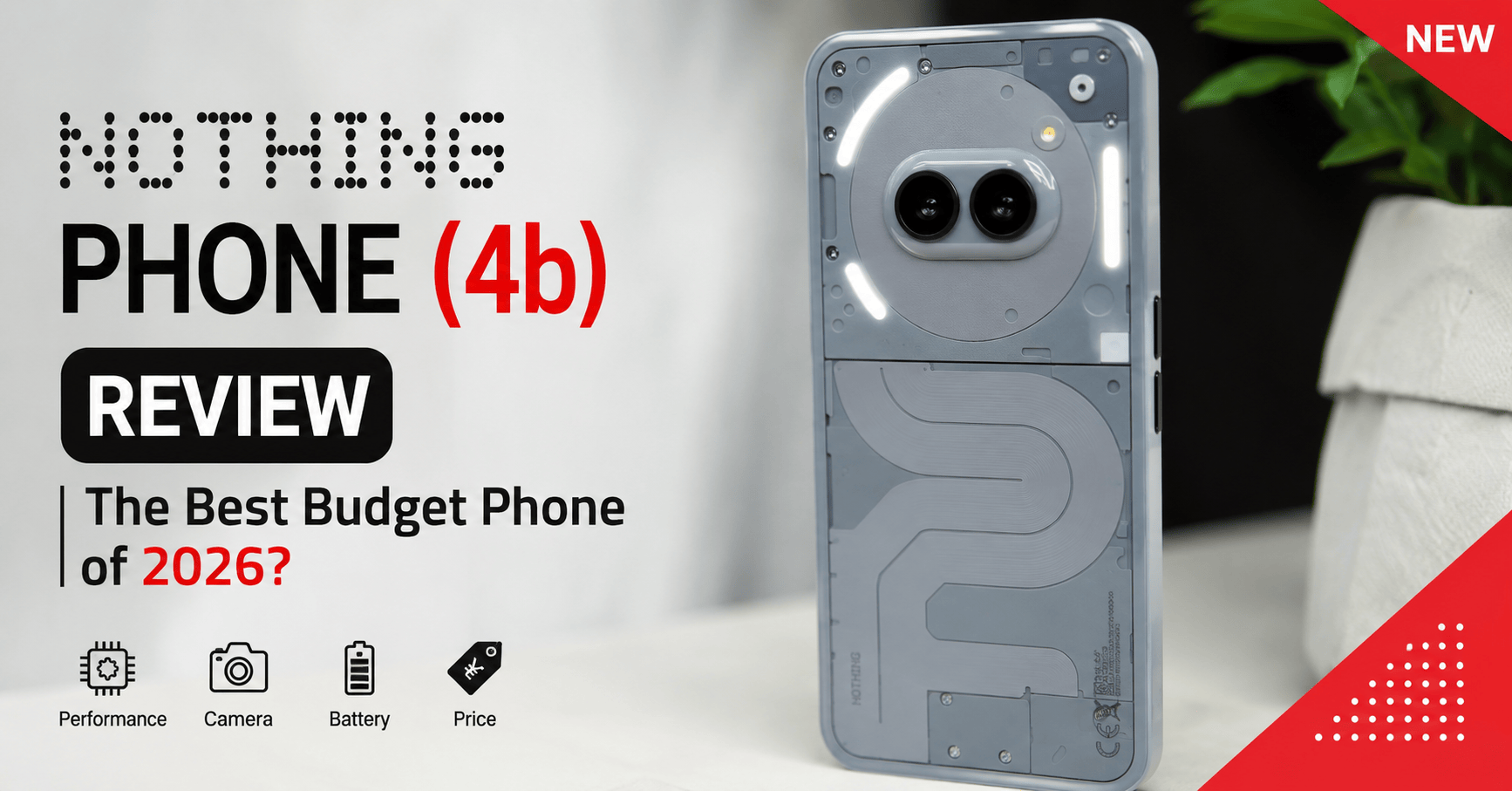

Nothing Phone (4b) In-Depth Review: The Ultimate Budget Experience?
The newly released Nothing Phone (4b), officially launched in July 2026, brings the brand’s signature aesthetic and smooth software to the sub-₹35,000 segment. Priced starting at ₹34,999 in India, it promises a balanced mix of unique design, clean UI, and marathon battery life. But does it deliver? Let us dive deep into every aspect of this device.

The sleek transparent aesthetic of the Nothing Phone (4b)
1. Design and Build Quality
Nothing is known for its head-turning designs, and the Phone (4b) is no exception. It features a unibody polycarbonate build that, despite being plastic, feels remarkably solid and premium in the hand. Weighing 210g and measuring 8.6mm in thickness, it has a substantial yet comfortable grip.
- The Glyph Interface: The transparent back panel is home to a scaled-down but highly functional Glyph Bar. It utilizes 45 individually controlled mini-LEDs divided into 5 distinct zones. You can use it for visual notifications, volume indicators, timers, and even as a recording tally light.
- Durability: The phone comes with an IP64 rating, meaning it is entirely dust-tight and can handle water splashes, though it is not meant for full submersion.
2. Display Excellence
The front of the device is dominated by a stunning 6.77-inch Super AMOLED panel with relatively symmetrical bezels.
- Resolution and Refresh Rate: It offers an FHD+ resolution (1080 x 2344 pixels) and an adaptive 120Hz refresh rate, ensuring scrolling and animations are buttery smooth.
- Brightness: With a peak brightness of 2,000 nits (and 1200 nits High Brightness Mode), the screen is perfectly legible under harsh direct sunlight.
- Protection: The display is protected by AGC Dragontrail Pro Glass and features an optical in-display fingerprint sensor that is reliably fast and secure.
3. Performance and Gaming
Under the hood, the Phone (4b) is powered by the 4nm Qualcomm Snapdragon 6 Gen 4 chipset. It is paired exclusively with 8GB of LPDDR4X RAM and comes in either 128GB or 256GB of UFS 2.2 storage.
While this is not a flagship gaming chip, it is an incredibly capable processor for the price. Day-to-day multitasking, browsing, and app-switching are seamless. For gamers, the device includes a large 4,400mm² copper vapor chamber for cooling. It can run popular titles like BGMI and COD Mobile at stable framerates (up to 90 fps) without unbearable thermal throttling or overheating.
4. Camera Capabilities
The camera setup is practical and avoids useless macro lenses. You get a dual-camera system on the rear:
- Primary Sensor: A 50MP main shooter (f/1.8) equipped with Optical Image Stabilization (OIS) and Phase Detection Autofocus (PDAF). It captures excellent daylight shots with natural color tuning, great dynamic range, and solid HDR processing. Low-light performance is decent but can show some noise.
- Ultra-Wide Sensor: An 8MP secondary lens with a 119.5-degree field of view. It is great for landscapes, though there is a noticeable drop in detail compared to the main sensor.
- Selfie Camera & Video: The front houses a 16MP selfie camera. For videography, the rear camera supports up to 4K recording at 30fps with gyro-EIS for smooth, stable video.
5. Software: Nothing OS 4.1
The software is undeniably the biggest selling point of the Phone (4b). It runs on Nothing OS 4.1, which is based on the latest Android 16. It offers a bloat-free, deeply customizable, and lightweight experience.
The signature monochrome theme looks striking, and Nothing has integrated useful AI features like “Essential Voice” and “Essential Search.” Furthermore, Nothing promises 3 years of major Android updates and an impressive 6 years of security patches, making it a highly future-proof investment.
6. Battery Life and Charging
Battery endurance is where the Indian variant of the Phone (4b) completely destroys the competition. While international markets get a 5200mAh cell, the Indian model packs a massive 6000mAh battery.
This translates to insane screen-on time. It easily lasts a day and a half to two days on a single charge under moderate use. When you do need to top up, it supports 33W fast wired charging (achieving 50% in about 80 minutes).
Nothing Phone (4b) – Full Specifications
| Network & Launch | |
| Technology | GSM / HSPA / LTE / 5G |
|---|---|
| Announced & Status | Announced: July 2026 | Status: Available |
| Body & Design | |
| Dimensions & Weight | Thickness: 8.6 mm | Weight: 210 g |
| Build | Glass front (Dragontrail Pro), Polycarbonate unibody frame and back |
| Durability | IP64 dust and water resistant |
| Special Features | Glyph Interface (45 mini-LEDs, 5 zones) |
| Display | |
| Type | Super AMOLED, 120Hz adaptive refresh rate, 10-bit color |
| Size & Resolution | 6.77 inches | 1080 x 2344 pixels (FHD+), ~395 ppi density |
| Brightness | 1200 nits (HBM), 2000 nits (Peak) |
| Protection | AGC Dragontrail Pro Glass |
| Platform & Performance | |
| OS | Android 16, Nothing OS 4.1 (3 Years OS Updates, 6 Years Security) |
| Chipset | Qualcomm Snapdragon 6 Gen 4 (4 nm) |
| Cooling System | 4,400mm² Copper Vapor Chamber |
| Memory & Storage | |
| RAM | 8GB LPDDR4X |
| Internal Storage | 128GB / 256GB UFS 2.2 (No microSD slot) |
| Main Camera | |
| Dual Setup |
50 MP, f/1.8, (wide), PDAF, OIS 8 MP, 119.5˚ (ultrawide) |
| Features | LED flash, panorama, HDR, Advanced Night Mode |
| Video | 4K@30fps, 1080p@30/60fps, gyro-EIS |
| Selfie Camera | |
| Single | 16 MP, (wide) |
| Video | 1080p@30fps |
| Sound & Connectivity | |
| Loudspeaker & Jack | Yes, with dual stereo speakers | No 3.5mm jack |
| Connectivity | Wi-Fi 802.11 a/b/g/n/ac/6, Bluetooth 5.3, GPS, NFC, USB Type-C 2.0 |
| Features & Battery | |
| Sensors | Fingerprint (under display, optical), accelerometer, proximity, compass |
| Battery Capacity | 6000 mAh, non-removable (Indian Variant) |
| Charging | 33W wired fast charging (50% in ~80 mins) |
| Pricing | |
| Price (India) | ₹34,999 (8GB + 128GB) |
The Verdict
The Nothing Phone (4b) is not trying to be a flagship killer; it is trying to be the most practical budget phone of 2026. If you want top-tier gaming performance or a telephoto zoom lens, you might want to step up to the Phone (4a). However, if your priorities are a striking design, exceptional battery life, a beautiful display, loud dual stereo speakers, and the cleanest software experience in the segment, the Phone (4b) is an absolute steal.